When bad jobs news is good for shares
On 7 August 2026, the United States reported that the economy lost 23,000 jobs in July — yet the S&P 500 closed at a record high the same evening. That looks like a contradiction. It is not. Here is the triangle of jobs, interest rates and share prices that every Student Investor should understand.
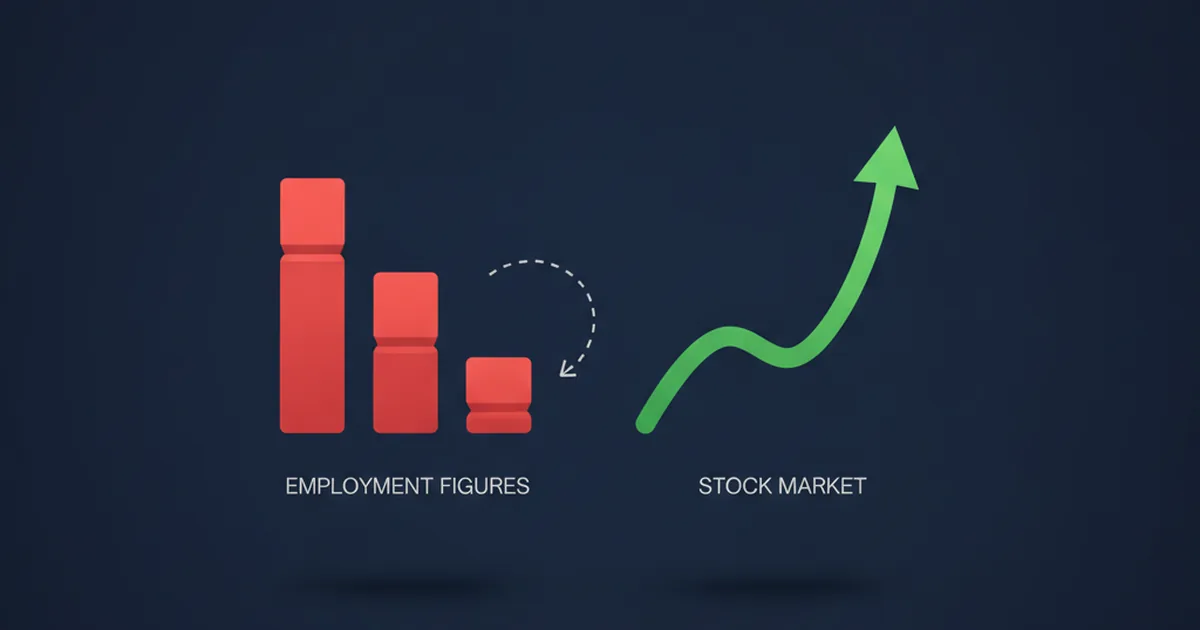
You have probably picked up the idea that a healthy economy is good for shares. If companies are selling more, hiring more people and turning a healthy profit, then in theory their shares should go up. So when a report lands saying the economy shed jobs last month, you might expect the stock market to fall. Usually that seems logical.
What actually happened on 7 August 2026 turned that logic on its head — and understanding why it did will make you a sharper reader of financial news for the rest of your life.
What the July 2026 jobs report actually said
Every month the US Bureau of Labor Statistics publishes what is known as the non-farm payrolls report: a count of how many jobs the US economy added or lost in the previous month, along with the unemployment rate. It is one of the most closely watched economic data releases in the world, because a country as large as the United States pulls the global economy in its wake.
On 7 August 2026, that report landed with a thud. The US economy shed 23,000 jobs in July, according to the Bureau of Labor Statistics. Economists surveyed by Dow Jones had expected the economy to add 83,000 roles — so the real figure was more than 100,000 worse than forecast. The government also revised the two previous months downwards by a combined 103,000, meaning the jobs market had been quietly softer than anyone realised. On top of that, wages barely moved, growing just 3.2% over the year — the slowest rate since 2021.
By most common-sense measures, that is a worrying picture. Fewer jobs means fewer people with wages to spend, which could slow down the companies that sell things. And yet, as CNBC and NBC News both reported, financial markets responded by pushing the S&P 500 — the index of America’s 500 biggest listed companies — to a fresh record high by the close of trading.
The triangle you need to know
To understand why this happens, you need to meet a third player that sits between jobs and share prices: interest rates, and the institution that controls them in the United States, the Federal Reserve (usually called the Fed).
Here is the triangle:
- Jobs → Fed rates. One of the Fed’s main jobs is to keep the economy in balance — not so hot that prices spiral out of control (inflation), not so cold that workers cannot find employment. It does this largely by setting a key interest rate. When the economy is strong and jobs are plentiful, the Fed tends to raise rates to cool things down. When jobs are scarce, it tends to hold rates steady or cut them to encourage hiring and spending.
- Fed rates → borrowing costs. The rate the Fed sets ripples through the entire financial system. Lower rates mean companies can borrow money more cheaply to invest, build factories and hire staff. Higher rates make borrowing more expensive, which tends to slow businesses down.
- Borrowing costs → share prices. When borrowing is cheap, companies can grow more easily and future profits look brighter, which pushes share prices up. There is also a mechanical reason: when interest rates are low, savings accounts and bonds pay less interest, so investors shift their money into shares hunting for better returns — and higher demand means higher prices.
Put those three steps together and you can see what happened in August 2026. A poor jobs report signalled to investors that the economy was softening — which made it far less likely the Fed would raise rates in the coming months. Futures markets, where traders make bets on Fed decisions, saw the odds of a September rate rise drop sharply on the day. With rates expected to stay low, the cost of borrowing looked set to remain cheap, which is a tailwind for company profits. Shares went up.
Why markets think several steps ahead
This connects to something we explore in what interest rates do to shares: the stock market is not a scoreboard for what has already happened. It is a constant attempt by millions of buyers and sellers to price in what they think will happen next. The July jobs figure was history by the time it landed. What mattered was what it implied about the future — specifically, about the path of interest rates over the months ahead.
This is why the same piece of news can be good or bad for shares depending on what it means for rates. A weak jobs number in a world where rates are already very low might just be bad news — it signals economic trouble without offering any prospect of rate cuts to offset it. But in August 2026, rates were still at a level where a softer economy plausibly meant the Fed would ease off, which markets welcomed.
Traders sometimes call this pattern “bad news is good news”, and it is one of the genuinely strange features of financial markets that catches newcomers off guard. It does not mean markets are broken or irrational — it means they are constantly trying to look around corners, factoring in causes and effects that are two or three steps removed from the headline.
Does it always work this way?
Not always, and that is an important caveat. The “bad news is good news” effect tends to work when:
- The economy is softening modestly rather than collapsing.
- Investors believe the central bank will respond with lower rates.
- Company profits are not yet at serious risk from the slowdown.
If the jobs picture gets bad enough that companies start warning about falling revenues — or if investors doubt the central bank can or will act — the same weak report might sink the market instead. Context and expectations are everything, which is why why shares move on earnings news keeps coming back to the idea that the reaction to any data point is really about how it compares to what people were already expecting.
The July 2026 figure also contained some genuinely worrying signals that tempered the enthusiasm. Over 260,000 people left the workforce entirely that month, and the unemployment rate only held steady because fewer people were actively looking for jobs. A fall in the workforce participation rate can mean people have given up searching — and that is not the kind of labour market news that tends to last as a tailwind for equities over the long run. Markets celebrated the rate implication on the day; the underlying picture was more mixed.
What this means for a Student Investor
None of this is a signal to go and buy anything — the whole point of the Challenge is to learn how markets behave with a virtual £100,000 portfolio, not to follow tips. But learning to read a jobs report through this lens makes you a more sophisticated watcher. A few habits to develop:
- Ask “what does this mean for rates?” Almost every major economic data release — inflation figures, retail sales, GDP growth — gets read first through the lens of what it implies for central bank policy. That is the starting question most professional investors ask.
- Notice the revision. The July 2026 report revised down the previous two months by 103,000 jobs combined. Revisions often go unnoticed in headlines but can change the whole picture of where an economy actually is.
- Separate the short-term reaction from the underlying trend. Markets moved up on the day because of what the report implied for rates. That does not mean a weaker jobs market is good for the economy over time — these are two different things running at different speeds.
The “bad news is good news” dynamic is one of those market behaviours that makes total sense once you understand the chain of reasoning, but feels completely wrong on first encounter. That is exactly the kind of pattern the Challenge is designed to help you spot — long before it starts making an appearance in GCSE economics lessons or university finance courses.
The takeaway
On 7 August 2026 the United States reported losing 23,000 jobs in July, missing expectations by more than 100,000 — and share prices hit a record. The reason is a triangle: a weak jobs report suggests the Fed will leave rates low, low rates make borrowing cheap and shares more attractive, so shares go up. Markets do not react to news in isolation; they react to what news implies about the future. Understanding that chain is one of the most useful frameworks you can carry into the Challenge, and far beyond it.
This article is educational and is not financial advice. Jobs figures are from the official Bureau of Labor Statistics Employment Situation report, July 2026. Market reaction reported by CNBC and NBC News, 7 August 2026.
Learn it by playing it
Build a virtual £100,000 portfolio and watch how jobs data, rate decisions and real-world events move share prices day by day.
See how it works