Rate-Hike Odds Hit 54% After Warsh’s Speech — How Markets Price a Rate Move
On 28 August 2026, Federal Reserve Chair Kevin Warsh delivered a hawkish message at the Jackson Hole symposium. Within minutes, futures markets had pushed the probability of a September interest rate hike from 35% to 54%. Here is what that number means, how markets produce it, and why it matters to every share investor.
What happened on 28 August 2026
Each August, central bankers from around the world gather at Jackson Hole in Wyoming for an annual economic symposium. The keynote speech by the US Federal Reserve Chair is the most closely watched event of the week. This year, it was the first such address by Kevin Warsh, who became Fed Chair in May 2026.
What traders were watching for: a signal on whether the Fed might raise interest rates again at its next policy meeting on 15–16 September. In the days before the speech, futures markets were pricing in roughly a 35% chance of a hike — meaning the market considered it possible but unlikely.
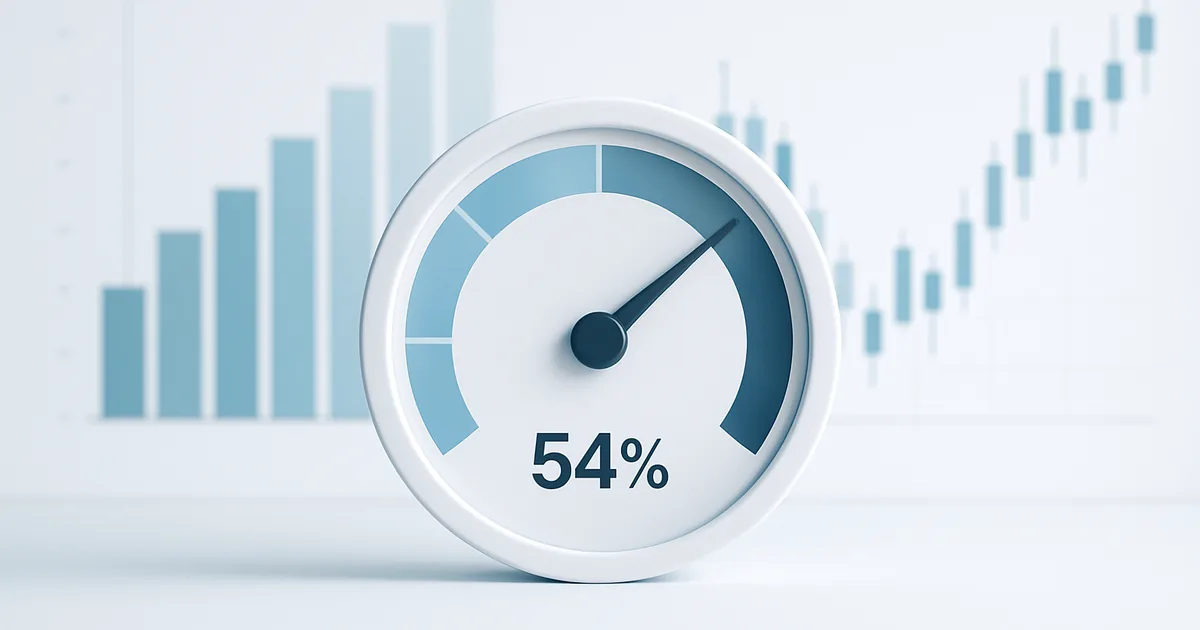
Warsh’s message was more hawkish than many had expected. He said the Fed would “have work to do” if policymakers were not confident that underlying inflation was heading back to the 2% target, according to CNBC. He recommitted firmly to the 2% PCE inflation target and said elevated prices should remain the central bank’s main focus. Within hours of his address, the probability of a September rate hike had risen to 54%, as Yahoo Finance reported, citing CME Group’s FedWatch tool.
The 2-year US Treasury yield — one of the most sensitive financial instruments to rate expectations — jumped roughly 9.5 basis points on the session, its sharpest single-day move in weeks. The S&P 500 fell 0.25% and the FTSE 100 also dipped, with gilt yields rising in London as a knock-on effect.
But what does a “54% probability” actually mean? And where does this number come from?
What is the CME FedWatch tool?
The CME FedWatch tool is a free resource published by CME Group, the company that operates the major futures exchanges in Chicago. It is one of the most widely used gauges for understanding where professional traders expect US interest rates to go next.
The tool works by reading the prices of financial instruments called federal funds futures contracts. These are essentially bets — bought and sold in huge volumes every day — on where the Federal Reserve’s main interest rate (the federal funds rate) will be on a specific future date. CME Group runs the mathematics in reverse: given these prices, what probability does the market assign to each possible outcome at the Fed’s next meeting?
If a September futures contract is priced at a level consistent with a rate between the current range and a higher range about 54% of the time, FedWatch will report a 54% chance of a hike. It is not a poll of expert economists. It is a snapshot of where real money is positioned right now.
Why does this number move so fast?
Futures prices update in real time throughout the trading day. Any new piece of information — a speech, an economic data release, a surprise jobs report — causes traders to instantly adjust their bets. That is why rate-hike probability can shift by 10 or 20 percentage points within minutes of a central banker speaking. Markets are aggregating the views of thousands of participants simultaneously, each updating based on the same new information.
Before you read about the Jackson Hole symposium itself, you might have expected the speech to be vague or ambiguous. In fact, Warsh’s language was specific enough that traders could model its implications quickly. That directness was itself a signal.
What Warsh actually said — and why it was ‘hawkish’
In central banking language, “hawkish” means favouring higher interest rates to control inflation. “Dovish” means preferring lower rates to support growth. These terms come from the image of a hawk (aggressive, focused) versus a dove (cautious, gentle).
Warsh’s tone at Jackson Hole was hawkish for three reasons:
- He focused on the inflation problem rather than the growth risk. A dovish Fed Chair might have spent more time discussing job market uncertainty or global economic headwinds. Warsh opened by emphasising that elevated prices “should be the central bank’s main focus.”
- He used conditional language that implied willingness to act. Saying the Fed would “have work to do” unless it was confident inflation was returning to target is a gentle threat. It tells the market: do not assume we are done raising rates.
- He recommitted to the 2% target without qualification. Some market participants had speculated that the Fed might quietly tolerate inflation slightly above 2% for longer. Warsh closed off that expectation explicitly.
None of this means a rate hike in September is certain. A 54% probability still means there is a 46% chance the Fed holds. But the speech shifted the balance of expectations meaningfully.
How the bond market confirms the shift
Share traders watch one bond market signal above all others when gauging rate expectations: the 2-year US Treasury yield.
A Treasury bond is a loan to the US government. When you buy a 2-year Treasury, you are lending the government money for two years at a fixed interest rate. The yield (the effective return you receive) moves inversely to the price: when prices fall, yields rise, and vice versa.
Why does the 2-year yield matter so much? Because two years is a short enough timeframe that its yield is driven almost entirely by what traders expect the Federal Reserve to do with interest rates in the near term. When rate-hike expectations rise, no one wants to hold an existing low-yield 2-year bond, so its price falls and its yield jumps. The jump on 28 August — roughly 9.5 basis points to around 4.325%, the highest level in a month — was a direct, real-money confirmation that traders had re-priced their rate expectations upwards.
Understanding what interest rates do to shares helps explain the next step in the chain reaction.
How a change in rate-hike odds reaches share prices
Interest rates do not only affect the cost of borrowing for companies. They also change what investors are willing to pay for future profits.
Here is the key idea: when rates are high, investors can earn a decent return from safe government bonds without any risk. That makes shares less attractive by comparison, since shares carry risk. So to compete, share prices have to fall until they offer a high enough potential return to justify the extra risk. This process is called discounting: higher rates reduce the “present value” of future earnings, pulling share prices lower.
Not all shares are affected equally, though. After Warsh’s speech, the pattern in the markets was familiar:
| Sector | Typical reaction to hawkish shift | Why |
|---|---|---|
| Technology / growth | Falls most | Profits years away are worth less when discounted at higher rates |
| Property (REITs) | Falls sharply | REITs borrow heavily and compete with bonds for income-seeking investors |
| Utilities | Falls modestly | Seen as bond proxies; dividends less attractive when bonds pay more |
| Banks | Can rise or fall | Higher rates improve lending margins but can raise default risk |
| Defensive (staples, healthcare) | Relatively resilient | Revenues stable regardless of the rate environment |
In your Student Investor virtual portfolio, checking which sectors are rate-sensitive is one of the most useful analytical habits you can build. A sudden shift in rate-hike odds is one of the clearest “macro signals” that professional investors track every day.
The difference between a speech and a decision
It is easy to confuse expecting a rate hike with a rate hike happening. They are not the same thing, and the distinction matters.
The next actual Federal Reserve decision is on 15–16 September 2026. Only then will the FOMC (Federal Open Market Committee) vote on whether to raise, cut, or hold rates. Between now and that meeting, several more pieces of data will arrive — including the August jobs report and the August Consumer Price Index — that could shift expectations again in either direction.
We saw a smaller version of this cycle just three days earlier, when the July PCE inflation reading pushed September rate-hike odds from 33% to 40%. The Warsh speech was a stronger signal, but the principle is the same: markets are continuously updating probabilities based on new information, and those probabilities translate into daily price movements in bonds and shares.
If August CPI, due in mid-September, comes in hotter than expected, those September odds could push towards 70% or higher. If it comes in softer, they could drop back below 40%. This is why investors do not react to just one data point — they are watching a stream of information and constantly revising their picture of what is most likely to happen next.
What to watch between now and the September meeting
- August US jobs report (early September): A strong labour market typically supports the case for higher rates. A softer one gives the Fed more room to hold.
- August CPI (mid-September): The headline inflation figure will be the most important data point between now and the decision. A surprise above or below forecast will move rate-hike odds sharply.
- Other Fed speeches: Other members of the FOMC will speak in the coming weeks. If they echo or soften Warsh’s message, that will either cement or reduce the probability of a September move.
- The FOMC meeting itself (15–16 September): Whatever the decision, Chair Warsh’s press conference afterwards will shape expectations for October and beyond.
If you are participating in the Student Investor Challenge, keeping a simple log of how your portfolio’s sector mix reacts to each of these events is excellent practice. Which of your positions rise when rate-hike odds go up? Which fall? Understanding those connections will make you a more thoughtful, informed participant — whether the rates story resolves hawkishly or not.
FAQ
What is the CME FedWatch tool?
The CME FedWatch tool is a free calculator from CME Group, which runs the Chicago futures exchanges. It reads prices from federal funds futures contracts — traded instruments that reflect bets on where US interest rates will be at a future date — and converts those prices into a percentage probability that the Fed will raise, cut, or hold rates at its next meeting. After Warsh’s Jackson Hole speech on 28 August 2026, FedWatch showed a 54% probability of a September rate hike, up from 35% the day before.
Why do markets react so quickly to central bank speeches?
Trillions of dollars worth of bonds, currencies, and shares are sensitive to interest rate expectations. When a central banker signals a shift, traders update their positions within seconds. Hawkish language — suggesting rates may rise — typically lifts bond yields, strengthens the currency, and weighs on rate-sensitive shares such as property companies and utilities. The speed reflects the fact that futures markets are live and continuously priced, so new information is absorbed almost instantly.
What does a rise in the 2-year Treasury yield signal?
The 2-year US Treasury yield tracks expectations of where the Federal Reserve will set interest rates over the next two years. When traders expect a rate hike, they require a higher yield to hold short-dated bonds, pushing the yield up. After Warsh’s speech on 28 August, the 2-year yield rose approximately 9.5 basis points to around 4.325% — one of its sharpest single-session moves in months — confirming that real money had repriced rate expectations significantly upward.
Apply macro signals to a real portfolio simulation
Track rate hike odds, bond yields, and earnings with a virtual £100,000 portfolio — no real money, real market lessons.
See how it works