What is a commodity?
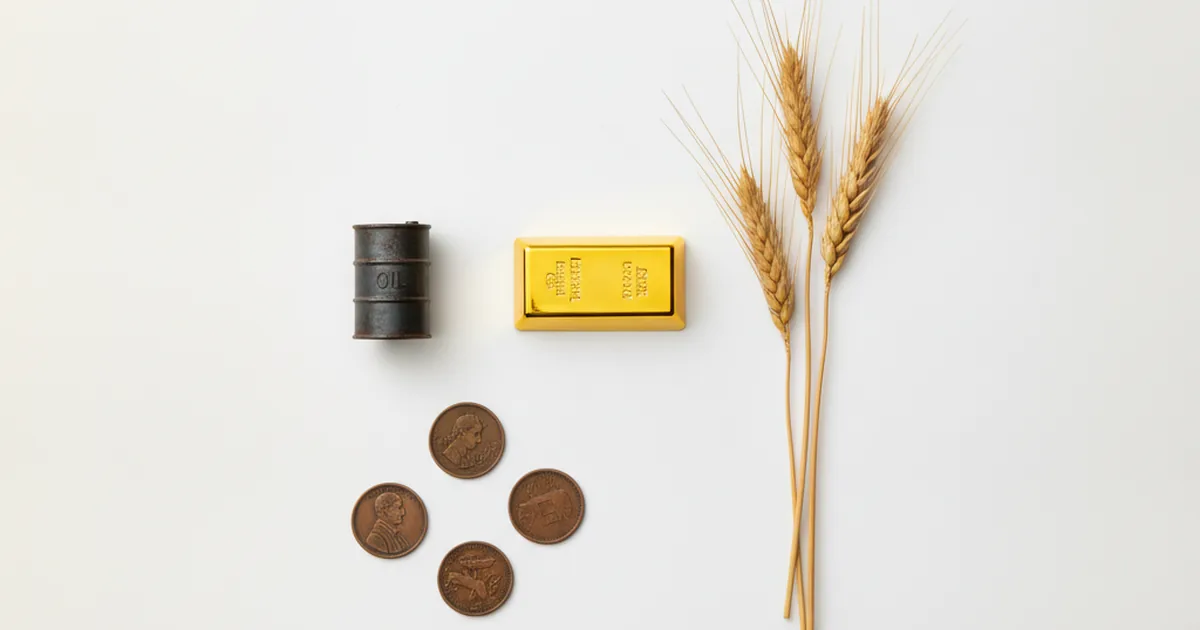
Gold, oil, copper, wheat — commodities power the global economy and move billions in shares. Once you understand what they are, market headlines start making a lot more sense.
Think about the last chocolate bar you ate, the flight your family took on holiday, or the battery in your phone. All of them have a price partly set thousands of miles away, on trading floors you have probably never heard of, by the raw materials that went into making them. That is the hidden hand of commodities at work.
A commodity is a raw material that is grown, mined, or extracted from the earth and then traded across the world. Unlike a smartphone or a designer jacket, one unit of a commodity is essentially identical to another — a barrel of Brent crude oil from the North Sea is, for trading purposes, the same as a barrel from anywhere else that meets the same spec. Economists call this being fungible, and it is the defining property of every commodity in existence.
In this guide we will look at what types of commodity exist, where and how they are traded, why their prices swing up and down, and — most usefully for a Student Investor — how those swings ripple straight through into the shares of familiar companies.
What counts as a commodity?
Commodities split into a few well-recognised families. Getting to know them makes it much easier to understand news about any individual raw material.
Energy
The energy family is the one that makes the biggest headlines. It includes crude oil (the two main benchmarks are Brent, priced in London, and WTI, priced in the US), natural gas, and coal. These commodities power factories, heat homes, fuel transport, and generate electricity. When energy prices spike, the effects ripple across almost every other industry, because almost every other industry uses energy to operate.
Metals
Metals divide neatly into precious and industrial.
Precious metals — chiefly gold and silver — have been used as stores of value for thousands of years. Gold in particular has a dual role: it ends up in jewellery and electronics, but it is also treated as a safe-haven asset, meaning investors pile into it when they are nervous about everything else.
Industrial metals are less glamorous but arguably more important to daily life. Copper goes into virtually every piece of electrical wiring on the planet; aluminium is used in cars, planes, and packaging; nickel is a key ingredient in stainless steel and, increasingly, in electric-vehicle batteries. When copper prices rise, it is often a signal that factories and construction sites are busy — which is why traders sometimes call copper “Dr Copper” and treat it as a barometer for the global economy.
Agricultural commodities ("softs" and grains)
This family covers the food and fibre the world runs on. Grains include wheat, corn (maize), and soybeans — staples that feed billions of people and animals. Softs is the trader’s term for crops like coffee, cocoa, cotton, and sugar. A poor harvest in any one of these can push up supermarket prices months later, which is why agricultural commodities quietly affect every household in the country.
Where are commodities traded?
Rather than being bought and sold in a single place, commodities trade on specialist exchanges that set globally recognised prices.
For metals, the most important exchange in the world is the London Metal Exchange (LME), which has been setting copper, aluminium, and nickel prices since 1877. For energy and agricultural products, the biggest exchange is CME Group in Chicago, which grew from the city’s long history as a grain-trading hub.
Two prices matter most:
- The spot price is the price for buying a commodity right now, for immediate delivery. When a news headline says “gold hit $3,000 an ounce”, it is usually talking about the spot price.
- A futures contract is an agreement to buy or sell a set amount of a commodity at a set price on a specific date in the future. The classic example is a wheat farmer who locks in a price for next harvest before the crop is even planted — it removes uncertainty for both the farmer and the buyer. Financial traders use futures too, to speculate on where prices are heading.
Most commodities are quoted in US dollars, wherever in the world you are buying them. That makes the dollar itself a significant factor in commodity prices — something we will come back to in a moment.
Why do commodity prices move?
No single force drives commodity prices. Instead, they sit at the intersection of several powerful influences, all pulling at once.
Supply and demand
This is the most fundamental driver. A drought in the American midwest can slash the wheat harvest and send grain prices higher because the same number of buyers are now chasing fewer tonnes. Conversely, if a new copper mine opens and adds a large volume to global supply, prices can soften even if demand is steady. Because commodities are physical goods, real-world events — a strike at a mine, a factory fire, a record harvest — translate directly into price moves.
Weather and geography
Nature is not evenly distributed. Hurricanes in the Gulf of Mexico can knock out oil rigs and refinery capacity for weeks. A late frost in Brazil — the world’s largest coffee producer — can destroy enough of a crop to lift global coffee prices sharply. The concentration of key resources in specific regions means that local weather events can have global price consequences.
Geopolitics
Wars, sanctions, and trade disputes can restrict the supply of commodities from major producing countries almost overnight. Russia’s importance to global gas markets, the Middle East’s share of oil production, and Chile’s dominance in copper mining all mean that political events in those regions can send shockwaves through commodity prices worldwide.
The US dollar
Because most commodities are priced in dollars, the value of the dollar itself matters a great deal. When the dollar strengthens, commodities become more expensive for buyers paying in euros, pounds, or yen — which tends to dampen demand and push prices lower. When the dollar weakens, the same barrel of oil becomes cheaper for non-US buyers, supporting demand and prices. It is a subtle but persistent relationship that you will notice once you start following markets.
How commodities move share prices
For a Student Investor, the most practical thing to understand is how commodity prices translate into movements in the shares you might hold. The direction of the impact depends entirely on whether the company is a producer or a consumer of the commodity.
Mining and resources companies — Rio Tinto, Glencore, BHP — earn most of their revenue by digging commodities out of the ground and selling them. When copper or iron ore prices rise, their revenues rise with them, profits jump, and the share price tends to follow. When metal prices fall, the reverse happens. Their fortunes are directly hitched to the commodity cycle.
Energy companies such as BP and Shell are in the same position: when the oil price rises, their profits swell; when it falls, margins shrink. A meaningful chunk of the FTSE 100 is made up of mining and energy companies, so commodity price swings affect the whole index in a visible way. You can read more about how oil price moves rippled through FTSE energy shares in a specific example on the blog.
Airlines sit on the other side of the equation. Jet fuel — refined from crude oil — is often the single biggest cost for carriers like easyJet or Ryanair. When oil prices rise, their cost base expands, profit forecasts fall, and the share price usually drops. The airline did nothing wrong; it is simply a consumer of a commodity that got more expensive.
Food and consumer goods companies face similar dynamics. Cocoa is a key input for Mondelez (the maker of Cadbury chocolate); wheat matters hugely to bread manufacturers. When soft commodity prices spike, these companies face a choice: absorb the extra cost and watch margins shrink, or raise their prices and risk losing customers.
Understanding which companies produce and which consume commodities helps you understand sectors and spot which part of the market is likely to benefit when a raw material moves.
Commodities and a portfolio
One reason professional investors pay close attention to commodities is that they do not always move in the same direction as shares. In periods of strong economic growth, both tend to rise together. But during inflationary periods, commodity prices can keep climbing even as share valuations get squeezed — meaning the two can partly offset each other in a mixed portfolio. That is one of the core ideas behind spreading money across different types of assets.
Commodities are also often discussed as an inflation hedge. If the pound is losing purchasing power, a barrel of oil or a tonne of wheat still holds its real-world value because it is a physical thing. You can read more about how inflation and commodity prices connect in our dedicated explainer.
For Student Investor participants, the Challenge portfolio is built from shares rather than commodity futures directly. But the connection is real: energy and mining stocks behave very differently from technology or consumer-goods stocks precisely because their earnings are driven by commodity prices rather than brand strength or software margins. Once you understand that, you can begin to read the commodity news ticker and form a view on how it might affect the shares you hold.
FAQ
Is gold a commodity?
Yes — gold is one of the most widely traded precious-metal commodities. It is used in jewellery and electronics but is also held as a store of value and safe-haven asset, meaning investors often buy it when they are nervous about other markets.
Can I invest in commodities through the Student Investor Challenge?
The Challenge focuses on shares listed on real stock exchanges, so you will not hold a barrel of oil directly. But you can buy shares in oil producers, miners, or agricultural companies — whose value is closely tied to commodity prices.
Why does the oil price affect an airline’s shares?
Airlines burn vast quantities of jet fuel, which is refined from crude oil. When oil prices rise, their costs go up and profits can fall — so the share price often drops even though the airline itself did nothing wrong. It is one of the clearest examples of a commodity rippling straight through to a company’s bottom line.
What is the difference between a commodity and a share?
A share gives you part-ownership of a company and a claim on its future profits. A commodity is a raw material with no earnings or management — its price is driven purely by supply and demand for the physical good itself.
See it move in real time
Track how energy and mining shares respond to commodity news in the Student Investor Challenge — with a virtual £100,000 and no real money at stake.
See how it works