What is a recession?
The word “recession” appears in news headlines every time the economy wobbles, and it always sounds alarming. But what does it actually mean — and, if one arrives, what should you expect to happen to the shares in your Student Investor portfolio?
The official definition: two quarters in a row
A recession has a precise technical meaning. It is not just a period of difficult news or falling share prices — it is a specific pattern in official economic data.
What GDP actually measures
GDP, or Gross Domestic Product, is the total value of all the goods and services an economy produces in a given period. Think of it as the economy’s overall output: every car built, every haircut given, every software licence sold, every meal served in a restaurant all count towards it. The Office for National Statistics measures UK GDP every three months — every quarter. When that number is positive, the economy grew. When it is negative, the economy shrank.
Why two consecutive quarters matters
A single quarter of negative GDP growth is not a recession. A bad winter, a one-off factory strike, a sudden global shock — any of these can produce a single bad quarter without signalling a deeper problem. The economy can bounce back the following quarter and nobody calls it a recession.
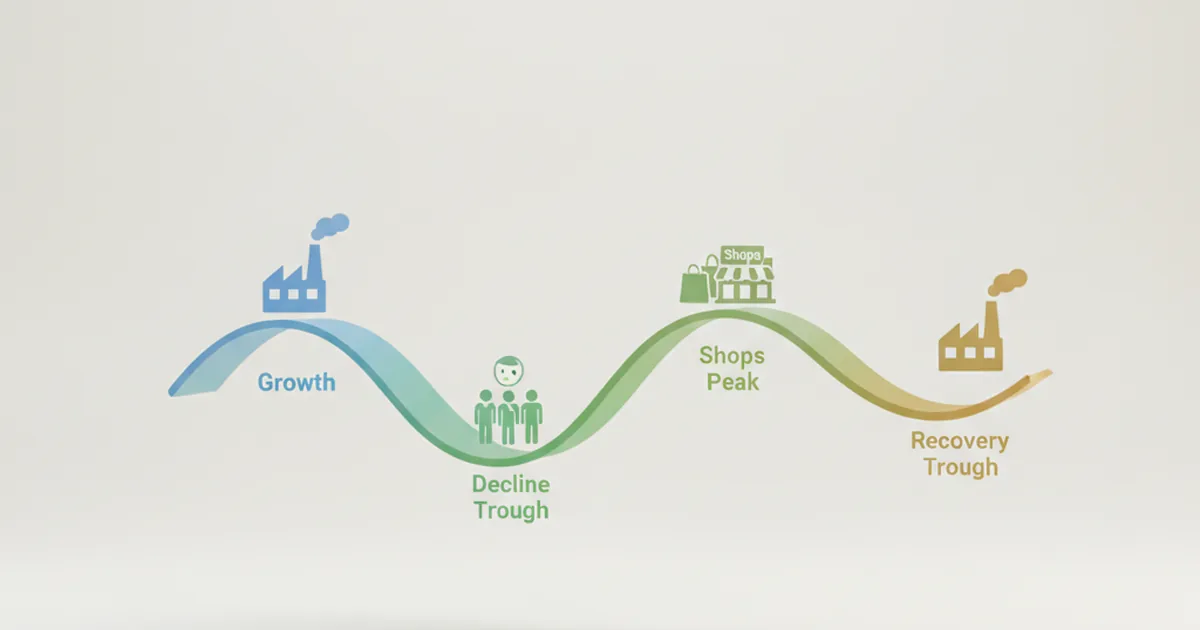
Two quarters in a row of negative GDP growth, however, is a different story. That sustained pattern is what economists and statisticians classify as a recession, and it is the definition used by the ONS and most advanced economies. Two consecutive quarters means the contraction is a clear trend, not a blip. The UK last met this definition during the financial crisis of 2008–09 and briefly again during the pandemic in 2020.
What causes a recession?
There is rarely a single cause. Recessions tend to arrive when several pressures combine and feed on each other. Here are the four most common triggers.
High inflation eroding spending. When prices rise fast, households have less money left after paying for essentials. Consumer spending drives roughly 60% of UK GDP, so when people cut back, the whole economy feels it. You can read more about how inflation and interest rates connect in our dedicated explainer.
Rising interest rates. The Bank of England raises its base rate to bring inflation down. Higher rates make borrowing more expensive for businesses investing in new equipment and for households taking out mortgages or loans. Both cut back, and economic activity slows. Read more about how the Bank of England uses rates and what it means for shares.
External shocks. A pandemic, an energy crisis, or a sudden trade war can shrink economic output almost overnight — regardless of whether domestic conditions were healthy. The 2020 lockdowns are the clearest recent example: the economy was not in trouble beforehand, but the external shock was severe enough to produce the deepest quarterly fall in UK GDP on record.
Falling confidence. Sometimes the expectation of a recession can help trigger one. If businesses expect demand to drop, they hire fewer people and delay investment. If consumers expect job losses, they save more and spend less. The economy does not need to be in trouble for these expectations to become self-fulfilling — which is why confidence surveys are taken seriously as economic indicators.
In practice, these causes overlap. The 2008 financial crisis, the 2020 pandemic recession, and the 2022–23 high-inflation squeeze each had different primary triggers, but all ended with the same result: GDP falling for at least two consecutive quarters.
What happens to shares in a recession?
Broadly, if economic output shrinks, companies sell less, profits fall, and share prices tend to fall with them. But the picture is more nuanced than that, for two reasons.
First, markets are forward-looking. Share prices often start falling before GDP data officially confirm a recession, because investors can see the warning signs — weak retail figures, rising unemployment, falling business orders — months before the ONS publishes its two-quarter verdict. Equally, markets often start recovering while the economy is still technically contracting, because investors are already pricing in the eventual recovery. This matters enormously for anyone trying to time their trades around economic data — by the time the headline arrives, the market has usually already moved.
Second, the impact varies enormously by sector.
Defensive and cyclical sectors
Not all companies suffer equally in a downturn. One of the most useful distinctions in investing is between defensive and cyclical stocks.
| Sector type | Examples | Why it behaves this way in a recession |
|---|---|---|
| Defensive | Utilities (electricity, water), food retailers, pharmaceuticals, healthcare | People keep paying their energy bills and buying groceries regardless of the economic climate. Demand barely falls. |
| Cyclical | Travel, luxury goods, house-builders, advertising, banks (when lending falls) | Spending on nice-to-haves is the first thing households cut when money gets tight. Revenues can fall sharply. |
You can explore how different sectors are classified in what is a stock market sector — understanding the defensive/cyclical split is one of the most practical tools a new investor has when thinking about how a portfolio might hold up in difficult conditions.
This is also the practical reason behind spreading your portfolio across different sectors. A portfolio heavily weighted towards cyclical companies can fall sharply in a recession; one that also holds defensive names tends to be cushioned.
It is worth noting the distinction between a recession and a bear market. A bear market is defined as a fall of 20% or more in a share index. The two often coincide, but they are separate things: markets can fall into bear territory on fear alone, and they can also fall during an economic expansion if confidence collapses for other reasons. Do not assume a falling market always means the economy is contracting, or vice versa.
Why bonds often move in the opposite direction
When a recession hits, central banks typically respond by cutting interest rates to make borrowing cheaper and encourage spending — the opposite of what they do when fighting inflation. The Bank of England did exactly this in 2009 and 2020.
That rate cut affects bond markets in an important way. Bonds issued when interest rates were higher pay out a fixed, higher income. When rates fall, new bonds offer lower payments, making the older higher-paying bonds more attractive — so their prices rise. This is why bonds and shares sometimes pull in opposite directions during a downturn. Read our explainer on what a bond is and how bond prices move for the full detail.
Bonds are often called safe-haven assets for this reason: when equity markets are falling and recession fears rise, investors tend to move money into bonds, pushing their prices up. A portfolio that holds both shares and bonds can therefore be more stable than one that holds only shares.
The market looks forward, not backward
One of the hardest things for new investors to get used to is the mismatch between when economic data is published and when markets actually move.
The ONS needs months of data collection, reporting, and revisions before it can officially confirm two quarters of negative GDP. By the time that confirmation arrives in the news, share markets have almost always already priced in the bad news. Investors watching rising unemployment, falling retail sales, and weakening business surveys have made their moves well before the official announcement.
The reverse is equally true. History shows that the best days in the stock market often happen while the economy is still technically in recession. Investors are not reacting to today’s GDP figure; they are placing bets on where the economy will be in six or twelve months. This is why trying to time investments perfectly around economic announcements is so difficult — even professional fund managers with vast resources frequently get it wrong. Staying calm and thinking long-term is almost always a better strategy than trading frantically on every headline.
What this means in the Student Investor Challenge
The Challenge is designed to teach you how to think under exactly these conditions — economic uncertainty, moving share prices, and sector rotation. A recessionary environment is one of the most instructive situations a new investor can experience, even in a simulation.
If recession fears are in the news, here is how to think about your virtual portfolio:
- Look at your sector exposure. Are most of your shares in cyclical industries like travel, retail, or construction? If so, a recession could hurt your holdings disproportionately. Defensive sectors — utilities, food, healthcare — may be worth considering as a balance.
- Check debt levels. Companies carrying a lot of debt face higher interest payments when rates rise and find it harder to survive falling revenues. A business with a strong balance sheet and low debt tends to be more resilient.
- Do not panic-sell. Recessions end. History consistently shows that investors who stay in the market through a downturn, rather than selling at the low point in a panic, tend to see better long-term outcomes. Selling during a recession means locking in losses and then having to decide when to buy back in — which is just as difficult.
FAQ
Is the UK in a recession right now?
Whether the UK is currently in a recession depends on the most recent ONS GDP data, which is published quarterly. You can check the latest figures on the ONS website. Remember: even when a recession is officially confirmed, markets have usually already reflected that news in share prices — they move on expectations, not on the announcement itself.
What is the difference between a recession and a depression?
A recession is a relatively short period of economic contraction — typically a few quarters to a year or two. A depression is a far deeper and longer version: much sharper falls in output, much higher unemployment, and a recovery that takes many years. The Great Depression of the 1930s was the most severe example in modern history. Recessions are a normal part of the economic cycle; depressions are rare.
Can shares go up during a recession?
Yes — and they often do, at least in parts of the market. Defensive sectors like utilities, food retailers, and pharmaceuticals can hold their value or even rise while cyclical shares fall. Bonds frequently rise as the Bank of England cuts rates. It is another reason why a diversified portfolio can behave very differently from a concentrated one.
What should I do with my Student Investor portfolio if a recession is announced?
In the Challenge, a recession announcement is a chance to practise exactly the kind of thinking real investors use. Look at your sector exposure, consider whether your holdings are mostly defensive or cyclical, and think about whether any repositioning makes sense given what you now know. There is no single right answer — the goal is to learn how to reason through it, not to predict the future perfectly.
Test your thinking in a real simulation
Student Investor gives you a virtual £100,000 to invest with no real money at risk — the perfect place to practise staying calm when recession headlines hit.
See how it works