What is cash flow?
A company can report a healthy profit and still run out of money. Cash flow is what tells you whether a business is actually generating real money — and it’s one of the most important numbers for anyone analysing shares.
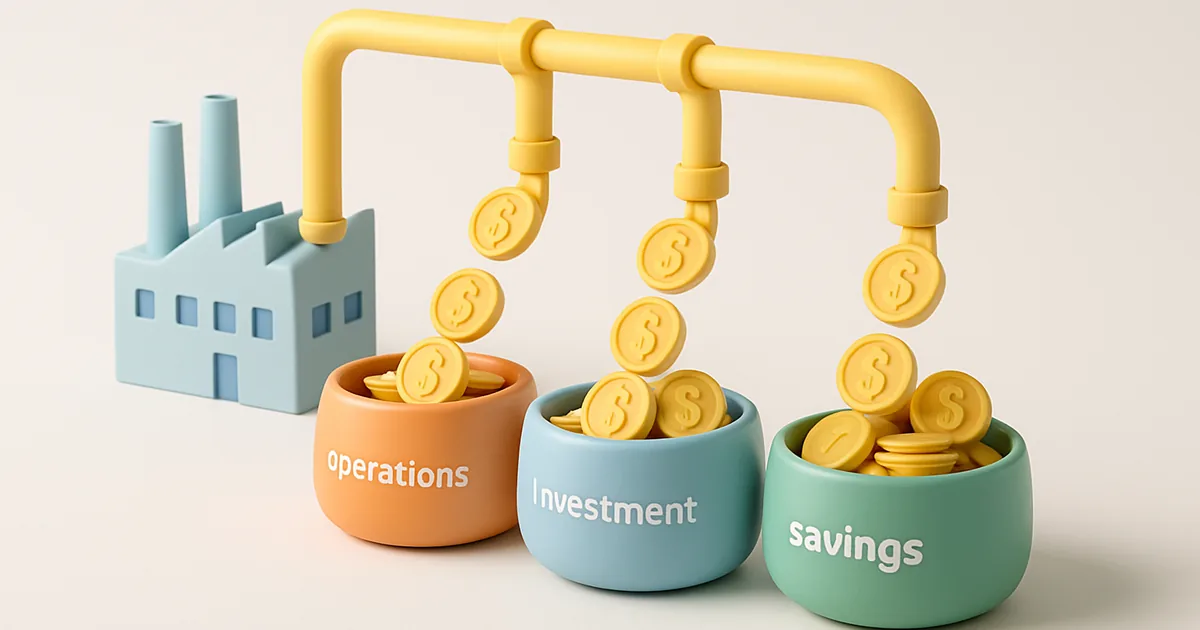
A company can post record profits on paper and still collapse because it ran out of cash to pay its suppliers. Cash flow is a separate measure from profit — and once you understand the difference, you will read company results with a much sharper eye. This explainer covers what cash flow is, how it is divided into three buckets, what free cash flow means, and how to use it when researching shares in the Student Investor Challenge. You have already seen how revenue and profit relate to each other; cash flow is the third pillar of the same story.
Profit is not the same as cash
This sounds obvious until you look at how accounting actually works. Under accrual accounting — the standard that almost all listed companies use — a sale is recorded the moment it is made, not when the money arrives in the bank. So a company that invoices a customer for £1 million in December counts that as December revenue, even if the customer does not actually pay until February.
Here is a simple way to picture it. Imagine a school sells 100 tickets for a ski trip at £200 each. The moment the tickets are sold, the school’s accounts show £20,000 of revenue — but the parents are paying in monthly instalments over four months. Meanwhile, the coach company wants its deposit upfront. The school looks profitable on paper yet is scrambling for real cash to pay the deposit.
The same thing happens in large companies, often at enormous scale. A fast-growing retailer might be expanding aggressively, building up inventory in warehouses and extending credit to wholesale customers. Its profit figure looks impressive because sales are being recognised. But the cash has not arrived yet — and the wages, rents, and supplier bills still have to be paid right now. Profit measures what a company earned; cash flow measures what actually hit the bank account. They can diverge sharply, especially during periods of rapid growth or economic stress. The technical term for this divergence is working capital tension.
The three buckets of cash flow
Every listed company publishes a cash flow statement as part of its annual report, alongside the income statement (profit and loss) and the balance sheet. The cash flow statement divides cash into three streams, each telling a different part of the story.
| Type | What it covers | What to look for |
|---|---|---|
| Operating cash flow | Cash from day-to-day business: selling goods and services, paying wages and suppliers | Should be positive and growing — this is the engine of the business |
| Investing cash flow | Cash spent on assets: factories, equipment, technology, acquisitions | Negative is often healthy (a company investing in growth); watch for unusual spikes |
| Financing cash flow | Cash from or to shareholders and lenders: share issues, dividends paid, loans taken or repaid | Shows how a company funds itself and rewards investors |
Operating cash flow is the most closely watched of the three. It shows whether the core business — the thing the company actually does every day — generates real money. A business with strong, growing operating cash flow can fund its own expansion without constantly going to the market to raise more money.
Investing cash flow is usually negative for healthy, growing businesses — and that is fine. If a supermarket chain is opening 20 new stores, it is spending cash on those sites. That looks like a cash outflow, but the investment should generate operating cash for years to come. Where you want to be careful is when investing cash flow spikes suddenly: a big acquisition might be transformational, or it might be a distraction that destroys value.
Financing cash flow reveals how the company is managing its relationship with shareholders and lenders. If a company is regularly issuing new shares to raise cash, that can dilute existing shareholders. If it is taking on more debt, that adds financial risk. If it is paying dividends consistently, that tells you something about its confidence in future cash generation.
Free cash flow — the number that really matters
Of all the cash flow metrics, free cash flow (FCF) is the one investors care about most. It answers a simple question: after keeping the business running and maintaining its assets, how much spare cash is left over?
The formula is straightforward:
FCF = Operating cash flow − Capital expenditure (capex)
Capital expenditure (capex) is the money a company spends maintaining and upgrading its assets — replacing worn-out machinery, upgrading IT systems, refurbishing stores. Even if a company is not expanding, it has to spend money just to keep things running. FCF strips that necessary spending out so you can see what is truly left over.
A concrete example: suppose a company generates £500 million in operating cash flow but needs to spend £200 million on new equipment to maintain its manufacturing plants. Its free cash flow is £300 million. That £300 million is what is available to pay dividends, buy back shares, reduce debt, or invest in new products. It is the real surplus — the “spare cash” after the lights are kept on.
Now suppose a rival company also reports £500 million in operating cash flow, but its ageing factories require £450 million in capex just to stay operational. Its FCF is only £50 million. Both companies look identical on operating cash flow; they are dramatically different on what they can actually do with their money.
Why cash flow matters when picking shares
One of the most common mistakes newer investors make is assessing a dividend purely on whether the company is profitable. The better question is: is the dividend covered by free cash flow?
A company with high earnings per share but weak free cash flow might look like a generous dividend payer on paper. But if FCF is thin, the dividend is being paid out of cash the company can barely afford to part with — or even borrowed money. When conditions get tougher, dividends paid from weak FCF tend to get cut first.
There are several warning signs that are worth watching out for when you read a company’s results in the Challenge:
- Operating cash flow shrinks while reported profit grows. This divergence is worth investigating. It often means the company is recognising revenue faster than it is collecting cash — a potential sign of aggressive accounting or deteriorating debtor quality.
- Investing cash flow suddenly spikes. A big acquisition can be exciting, but it can also be a distraction. Check whether the company has a good track record of making acquisitions work.
- Financing cash flow shows consistent borrowing to pay dividends. A company that borrows money to maintain its dividend is in a fragile position. This cannot continue indefinitely, and when it stops, the share price often falls sharply.
- Free cash flow is negative for several consecutive years. The odd negative year during a major investment cycle is fine. Multiple years of negative FCF in an established business is a red flag worth examining carefully.
None of these signals is automatically fatal — context matters enormously. But they are questions to ask, not facts to ignore.
How to find a company’s cash flow data
When you are researching a share for the Challenge, the cash flow statement sits alongside the income statement and balance sheet in the company’s annual report. Here is where to look:
- Company investor relations pages. All listed companies maintain an investor relations section on their website where they publish results announcements, annual reports, and half-year reports.
- Regulatory News Service (RNS) filings. When a company announces results, it files them through the RNS, which is publicly accessible. You can find these via the London Stock Exchange company filings pages.
- The annual report itself. The cash flow statement is one of the three primary financial statements. In most UK annual reports it is labelled “Consolidated Statement of Cash Flows” and appears after the income statement and balance sheet.
When you are researching a share for the Student Investor Challenge, make it a habit to look at the cash flow statement alongside the income statement — they tell very different stories about the same business. For a step-by-step guide to the full research process, read our piece on how to research a share before you buy.
A quick example — same profit, very different cash
To make this concrete, here are two fictional companies that both report an identical profit figure. Their cash flow pictures could not be more different.
| Company A | Company B | |
|---|---|---|
| Reported profit | £80m | £80m |
| Operating cash flow | £95m | £35m |
| Capital expenditure (capex) | £20m | £30m |
| Free cash flow | £75m | £5m |
| Dividend safe? | Likely yes | Risky |
Company A actually earns more cash than it shows in profit — a strong sign of cash conversion. Its free cash flow of £75m leaves plenty of room to pay a dividend, invest in growth, and reduce debt. Company B earns far less cash than its profit figure suggests. Its dividend is precarious — any bump in costs or dip in sales could force a cut. Two companies, same reported profit, very different investment cases once you look beyond the headline figure.
Frequently asked questions
Is cash flow more important than profit?
Neither is more important on its own — they measure different things. Profit shows whether a business model is working; cash flow shows whether it is sustainable. Smart investors look at both together. A company with rising profit and strong free cash flow is usually in a much healthier position than one where those two numbers are pulling in opposite directions.
Can a profitable company go bust?
Yes — and it happens more often than you might expect. If a business runs out of actual cash because it is tied up in unpaid invoices or slow-selling stock, it cannot pay its suppliers, staff, or lenders even if it looks profitable on paper. This is sometimes called a liquidity crisis, and it is entirely separate from whether the company’s underlying business model is sound. Cash flow matters because it tells you whether the business can actually survive day to day, not just whether it looks good on an annual report.
What does negative cash flow mean?
It depends on which type you are looking at. Negative investing cash flow is common and often healthy — it usually means the company is spending on growth, new equipment, or acquisitions. Negative operating cash flow, on the other hand, is a warning sign: the core business is burning through cash just to keep running. A company can sustain negative operating cash flow for a while if it has reserves or can raise money from investors, but it cannot do so indefinitely. Always check the reason behind a negative number before drawing conclusions.
Put it into practice
Apply these concepts with a virtual £100,000 portfolio — no real money, real companies, real results announcements.
See how it works