Why supply chains move share prices
In early August 2026 an aerospace giant reported higher sales — and watched its shares fall about 20% in a single day. The reason was not a bad quarter. It was a missing part. Here is what a supply-chain crunch teaches a Student Investor.
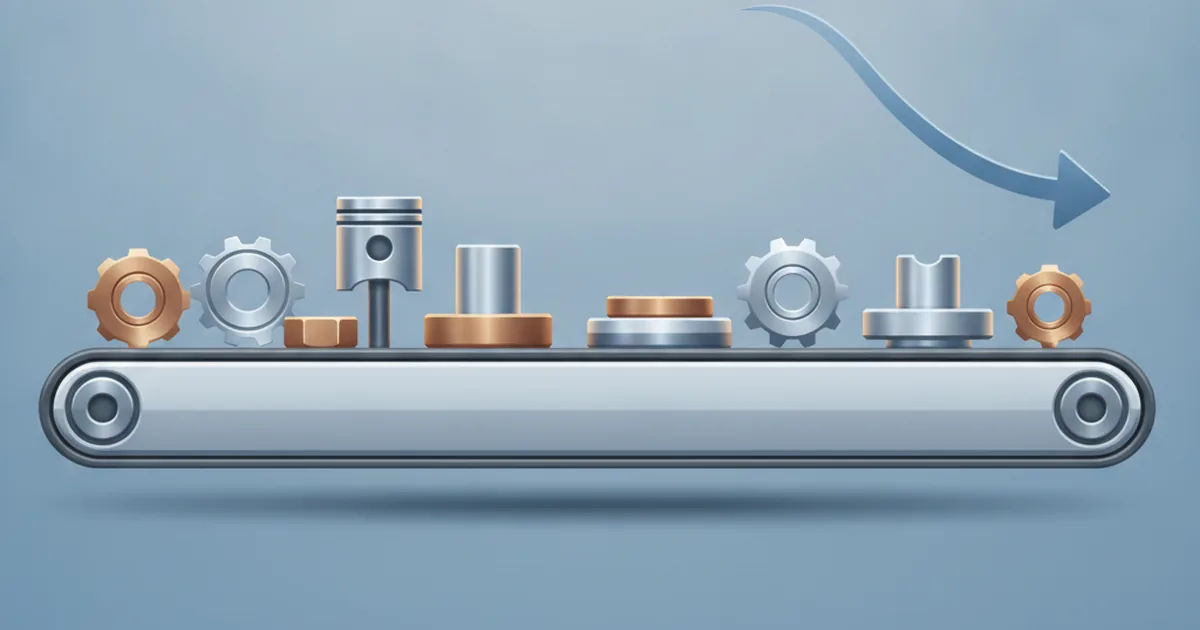
When we talk about the stock market, it is easy to picture it as a world of pure numbers — profits, forecasts, percentages on a screen. But behind every share is a real business that has to make real things, and to make things it needs parts. When those parts stop turning up, the trouble travels all the way from the factory floor to the share price. The first week of August 2026 gave us a textbook example, and it is one of the clearest lessons a young investor can learn.
What actually happened
On 6 August 2026, Honeywell Aerospace — a large maker of jet engines, cockpit systems and aircraft parts that had only recently become its own separately listed company — published a fresh set of results. The headline figures were not a disaster. Sales rose about 5% from a year earlier to roughly $4.5 billion. In isolation, that is a company still growing.
Yet the shares dropped around 20% on the day, one of their worst falls on record. What spooked investors was not the past quarter at all. It was what the company said about the rest of the year: it cut its full-year forecast for organic sales growth from a range of 7–9% down to just 4–5%, and trimmed its profit outlook too. The cause it gave was strikingly physical — a shortage of precision castings, the specialist moulded metal parts that go inside its products.
According to the company's own results statement and reporting from Reuters, the crunch was severe enough that Honeywell Aerospace had to send its scarce parts towards building brand-new engines for planemakers like Boeing and Airbus, leaving less for its higher-margin repairs-and-spares business. In plain terms: it could not get enough of one crucial component, so it had to choose where to use what it had — and that choice cost it profit.
What a supply chain is — and why it matters
A supply chain is the whole line of suppliers, factories and shippers a company depends on to turn raw materials into a finished product it can sell. A phone maker needs chips and glass; a bakery needs flour and ovens; an aerospace firm needs specialist metal castings that only a handful of suppliers in the world can produce to the required standard.
The important idea is that a chain is only as strong as its weakest link. A company can have brilliant engineers, loyal customers and full order books, and still be stopped in its tracks by one missing part it cannot make itself. When that happens, three things tend to follow:
- It cannot sell what it cannot build. Orders may be waiting, but revenue only lands when the product ships.
- Costs often rise. Scarce parts get more expensive, and scrambling to find alternatives eats into profit margins.
- Management has to make hard choices. Like Honeywell Aerospace, a firm may have to favour one customer or product line over another, which shifts where the money comes from.
None of this shows up as a dramatic scandal. It is quiet, operational and physical — and yet it can move billions in market value in an afternoon.
The real lesson: prices live in the future
Here is the part that ties it all together, and it is the single most useful idea for a Student Investor. A share price is not a report card for last quarter. It is closer to a bet on the years ahead. Thousands of investors are constantly trying to guess what a company will earn in the future, and the price reflects the best current guess.
So when Honeywell Aerospace cut its own forecast, it did not just describe one rough patch — it lowered the market's expectation of its future earnings. The shares fell to match the new, dimmer picture. This is exactly the mechanism we explore in why shares move on earnings news: it is rarely the raw number that moves a stock, but the number measured against expectations, coloured by what the company says comes next.
It also explains the puzzle in the headline. "Sales up 5%, shares down 20%" only looks contradictory until you remember that investors had been expecting more, and were just told to expect less going forward. The past improved a little; the future got marked down a lot. The future won.
Why this is a gift for a Student Investor
To be clear, none of this is a hint to buy or sell anything — the Challenge is about understanding how markets work, not about tips. But a supply-chain story like this one is a brilliant, free way to sharpen the way you read the market. A few things to take from it:
- Look past the headline number. "Sales rose 5%" and "shares fell 20%" are both true at once. Learning to hold two facts like that together, and ask why, is most of the skill.
- Ask what a company depends on. Every business leans on something it does not fully control — a supplier, a raw material, a single big customer. Those dependencies are where nasty surprises hide.
- Watch the guidance, not just the results. A cut forecast is often a bigger deal than a soft quarter, because it changes the story about the future.
- Notice how one event ripples. A casting shortage did not just hit Honeywell Aerospace; it touches its suppliers, its airline customers and even rivals. Markets are a web, and this is a good week to watch it move.
This is also a natural moment to think about spreading your bets. If a single missing part can knock 20% off one company in a day, you can see why owning a mix of different businesses — the idea behind diversification — softens the blow when any one of them stumbles. A steady, spread-out approach is usually kinder to a portfolio than chasing whichever share just moved, which is why holding tends to beat trading for most beginners.
Bring it into the Challenge
The best way to make all this stick is to watch it happen with money that cannot hurt you. A virtual £100,000 portfolio lets you follow a real story like the Honeywell Aerospace fall — reading the results, spotting the cut forecast, and seeing how the price reacts — without risking a penny. Do that a few times and the language of the market stops sounding like a foreign tongue.
The takeaway
A company is not just a line on a chart; it is a real operation that has to get real parts through a real supply chain. When one link jams, even a growing business can be forced to lower its sights — and because share prices are built on expectations of the future, that lowered outlook can hit the stock hard and fast. Honeywell Aerospace growing its sales yet dropping 20% is the whole idea in one day: in investing, what a company expects tomorrow usually matters more than what it did yesterday.
This article is educational and is not financial advice. Figures on Honeywell Aerospace's second-quarter 2026 results, revised guidance and share-price move are as reported in the company's official results statement (via PR Newswire) and by Reuters for 6 August 2026.
Learn it by playing it
Build a virtual £100,000 portfolio and watch how results, forecasts and real-world shocks move a share price.
See how it works