How banks actually make money
In late July 2026 NatWest announced a £3 billion profit for the first six months of the year. Its shares jumped about 4%. But where does that money come from, and why should you care as an investor?
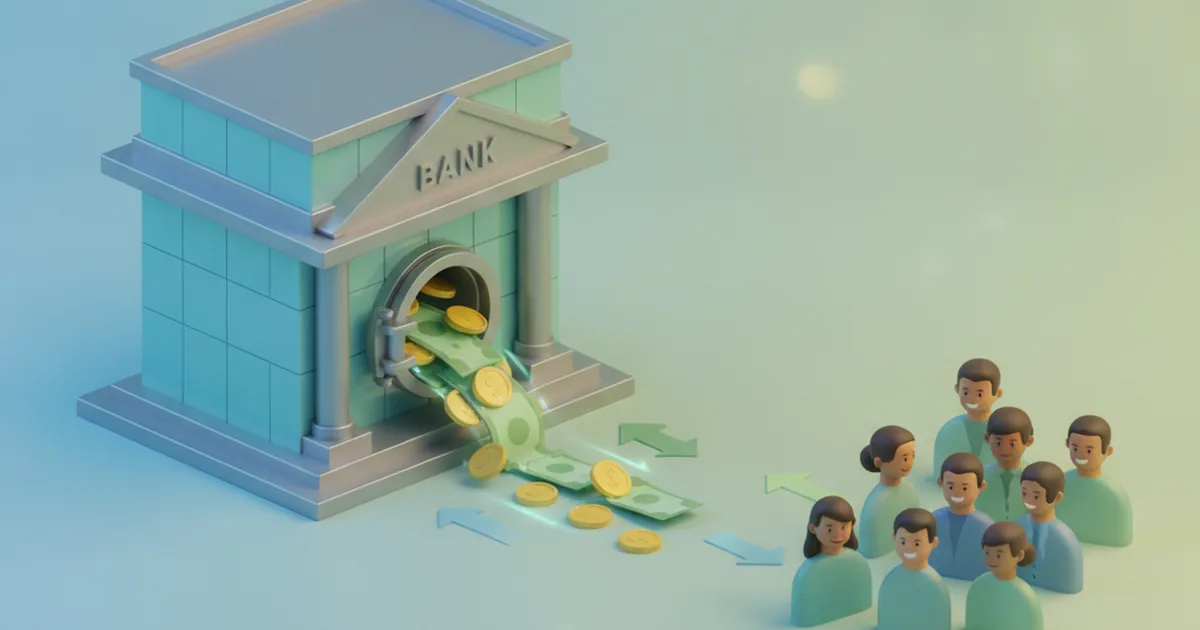
Most people have a rough idea that banks are profitable. But few can explain exactly how they turn a savings account and a mortgage into billions of pounds of annual income. Understanding this is genuinely useful, because banks are some of the largest companies in the FTSE 100 — and their profits move in a very predictable way when interest rates change.
NatWest’s first-half 2026 results, published on 31 July, are a good place to start. The bank reported £3 billion in profit for the six months to June, with earnings per share up 23% year on year. Its shares rose around 4% on the news. To understand why, you need to know how a bank earns its money in the first place.
A bank is a borrowing and lending machine
The simplest way to think about a bank is as a middleman. On one side sit millions of people with savings they do not currently need. On the other side sit individuals and businesses who want to borrow money for mortgages, car loans, or business investment. The bank connects the two: it takes in the savings and lends them out, charging more for the loans than it pays on the deposits.
The gap between those two rates is the engine of a bank’s profit. Here is a stripped-down example:
- You deposit £1,000 and the bank pays you 2% interest — that is £20 a year it owes you.
- The bank lends that £1,000 to a homebuyer as part of a mortgage at 5% interest — it earns £50 a year from them.
- The bank keeps the £30 difference. Scale that across hundreds of billions of pounds of loans and deposits, and you have a very large business.
That gap has a proper name: the net interest margin, usually written as NIM. It is measured as a percentage. NatWest’s NIM in the first half of 2026 was 2.48%, up from 2.28% in the same period a year earlier. A rise of 0.2 percentage points sounds tiny, but applied to roughly £280 billion in loans it produced an extra £560 million in income over six months.
Why interest rates matter so much to bank profits
That improvement in NatWest’s margin did not happen randomly. It happened because the Bank of England’s base rate stayed at a relatively elevated level through the first half of 2026. Understanding why that matters is one of the more useful things you can learn about markets.
When the Bank of England raises its base rate, the rate that banks charge on new and variable-rate loans tends to go up quickly. A tracker mortgage, for example, is contractually linked to the base rate and adjusts almost automatically. But the rate banks pay on savings accounts moves much more slowly — savers rarely switch on the same day rates change, and banks have little commercial pressure to pass on every rise at once.
The result is a widening gap between loan rates and deposit rates — a fatter margin — which is exactly what NatWest was reporting. In the guide to what interest rates do to shares, we looked at how rising rates can squeeze company valuations by making future profits seem less valuable today. Banks are one of the few sectors that can actually benefit from the same rate rises, because their revenue model works in the opposite direction.
The flip side is equally worth knowing. When rates are cut — as the Bank of England did several times in 2024 and 2025 — the margin tends to compress. Banks have to charge less on new loans but can still be paying relatively high rates on long-term savings products. Squeezing the margin squeezes profits, and bank shares often fall on rate-cut expectations.
The other ways banks earn income
Net interest income is the biggest piece, but not the only one. Banks also collect fees, which are grouped together as non-interest income. For NatWest in H1 2026, total income came to £8.9 billion — so after the net interest income of £6.9 billion, roughly £2 billion came from:
- Payment and transaction fees — charges for processing card payments, international transfers, and currency exchange.
- Arrangement fees — one-off charges when the bank sets up a large business loan or commercial mortgage.
- Wealth management fees — annual charges for managing investments on behalf of wealthier clients.
- Trading income — profits from buying and selling financial instruments such as government bonds or currencies on behalf of corporate clients.
Once you subtract operating costs (staff wages, branch networks, technology, the cost of loans that go bad) from those two income streams, you arrive at the profit. NatWest’s £3 billion figure represented a return on tangible equity of 19.7% — a measure of how efficiently the bank is using the money its shareholders have put in. That is considered a strong return for a UK high-street bank.
Why the share price moved on results day
Here is the part that trips up many beginners: a company’s shares rarely move just because it made a profit. They move because the profit was different from what the market expected. Before any set of results is published, a community of financial analysts who follow the company closely has already made a public forecast. That collective forecast is effectively baked into the share price before results day arrives.
If NatWest had posted exactly the profit that analysts predicted, its shares would probably have barely moved — the news was already priced in. But NatWest delivered profits above expectations and raised its guidance for the full year, telling investors to expect total income of around £17.9 billion across all of 2026. Better-than-forecast results combined with a raised outlook is one of the more reliable triggers for a share price jump, which is why the 4% rise on results day made sense.
For more on how the surprise element drives price moves, the post on why shares move on earnings news goes into this mechanic in more detail.
How profits reach shareholders
NatWest did not hold onto the entire £3 billion. Alongside the results it announced an interim dividend of 12p per share — up 26% on the prior year — and confirmed plans for a share buyback later in 2026. Both of these are ways a company returns cash to the people who own it.
A dividend is a straightforward cash payment: if you own shares, the money goes into your account. A buyback works differently: the company uses its spare cash to buy its own shares back from the market, reducing the total number in circulation so each remaining share represents a slightly bigger slice of the business. Both are worth understanding, and our guides to what a dividend actually is and what a share buyback is explain each mechanic in full.
The risk side of banking
Understanding the profit model means understanding the risks too. Banks borrow short and lend long — they take deposits that customers can withdraw at any time, then tie that money up in twenty-five-year mortgages. As long as most customers are not trying to withdraw everything at once, the system works smoothly. If confidence breaks down and a large number of depositors try to get their money back at the same time, the bank can face severe stress. This is called a bank run, and it is one of the reasons governments regulate banks so closely and require them to keep a buffer of easily accessible cash and capital on hand.
There is also credit risk: the possibility that some borrowers cannot repay their loans. When the economy turns down, unemployment rises and some mortgage holders fall behind on payments. Banks have to set aside money to cover expected losses — these provisions reduce profit and can turn a good year into a bad one if conditions deteriorate sharply. NatWest’s strong 2026 results reflected a period when the UK economy was holding up reasonably well and loan defaults stayed low.
What this means in the Student Investor Challenge
NatWest, Barclays, HSBC, and Lloyds together make up a significant chunk of the FTSE 100 by market value. If you hold shares in any broad UK market index fund or ETF — or if you hold any of the big banks directly in your virtual portfolio — you are exposed to the profit model we have been describing.
The practical takeaway is this: when you see a piece of news about interest rates, ask yourself what it implies for bank margins. A rate hold or a surprise rate rise is generally good for bank profitability in the near term; a rate cut puts pressure on it. When results season comes around (UK banks typically publish half-year results in July and August), check whether the actual numbers beat or missed what analysts expected — that gap, not the profit figure in isolation, is what moves the share price.
More broadly, NatWest’s 2026 results are a reminder that some of the most interesting investor lessons come not from exotic tech companies but from familiar high-street names doing something very straightforward — and doing it with extraordinary scale.
FAQ
What is a net interest margin?
It is the gap between the interest rate a bank charges on loans and the rate it pays on deposits, expressed as a percentage. NatWest’s NIM of 2.48% in H1 2026 means it earned 2.48p of net interest for every £1 it had out on loan.
Why do bank profits rise when interest rates are high?
Loan rates go up quickly when the Bank of England raises its base rate; savings rates rise more slowly. That delay widens the margin between what a bank earns and what it pays — and a wider margin means more profit.
What does “earnings beat” mean?
It means the company’s actual profit was higher than the forecasts analysts had published before results day. Because those expectations are already baked into the share price, a positive surprise tends to push the price up.
Should I hold bank shares in the Student Investor Challenge?
That is your team’s call. Banks are large, well-known names with dividends and results that move clearly on interest rate news — which makes them relatively understandable. The risk is that they can suffer when the economy slows and loan defaults rise. Understanding the business model lets you make a reasoned choice rather than guessing.
Learn it by playing it
Build a virtual £100,000 portfolio and see how real companies behave.
See how it works