Why energy bills are rising this October — and what it means for shares
Ofgem has confirmed a 4% rise in the energy price cap from 1 October 2026, pushing typical household bills up by around £60 a year. For student investors, this is more than a story about household budgets — it is a chain reaction that runs through inflation, Bank of England decisions, and share prices across the market.
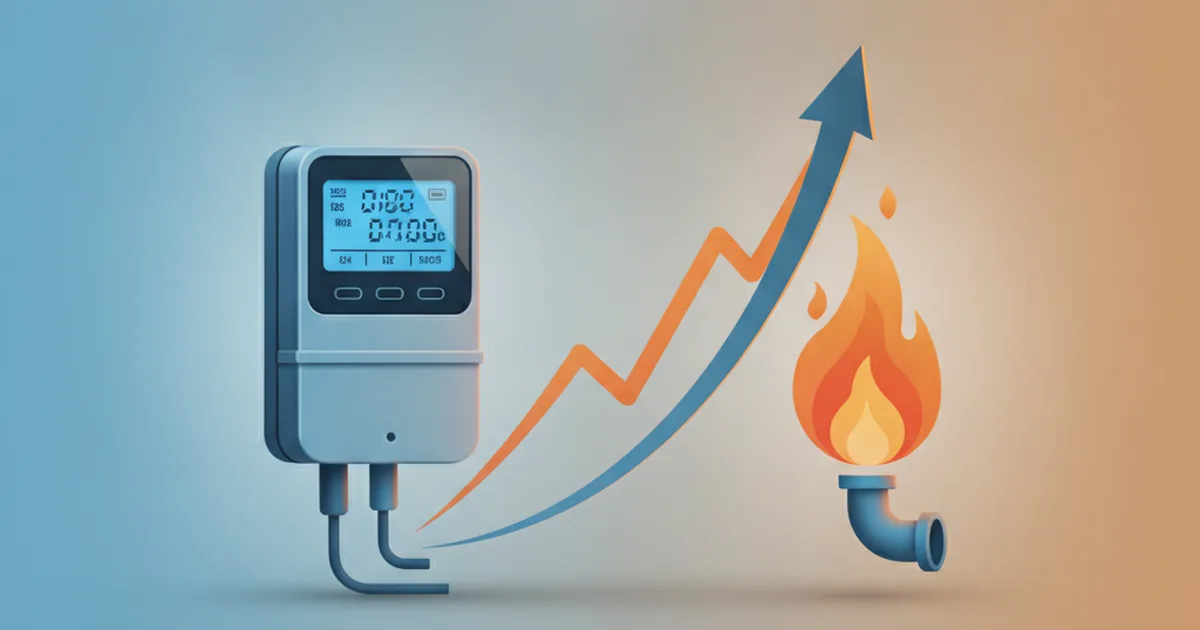
Every three months, the UK’s energy regulator reviews how much suppliers can charge households for gas and electricity. That review, run by Ofgem, sets the energy price cap — and in its most recent announcement, Ofgem confirmed that from 1 October 2026 the cap will rise by 4%. For a typical household on a default tariff using both gas and electricity, that means annual bills rising by roughly £60, to around £1,723.
Around 22 million homes are on these default tariffs and will feel the change immediately. Those on fixed deals — about 35% of households — are shielded for now. But the effects do not stay inside household budgets. They travel through inflation, into interest rate expectations, and from there into the stock market. Here is how that chain works, and what it means if you are tracking shares in the Student Investor Challenge.
What is the energy price cap?
The energy price cap does not cap how much your total bill is. It caps the rate per unit of gas and electricity that suppliers can charge. If you use more, you still pay more — the cap just limits the price per kilowatt-hour. Ofgem reviews it quarterly, basing changes on wholesale energy costs, network charges, and other supplier costs.
The system was introduced in 2019, but it came to public attention during the global energy crisis of 2021 and 2022, when wholesale gas prices surged and the cap had to rise sharply to keep pace. Since then, prices have partially fallen back, but they have remained volatile — and the Q4 2026 rise shows that volatility has not gone away.
Why is the cap rising now?
The main driver is wholesale gas prices, which have climbed over recent months. Gas bills for typical households will rise by 8% under the new cap, while electricity-only households — those with heat pumps or full electric homes — will see a rise of less than 1%, because most of the increase is gas-related.
The global gas market is sensitive to geopolitical events, and much of the current pressure traces back to tensions around the Strait of Hormuz, a narrow waterway through which a significant share of the world’s oil and gas shipments pass. When tensions rise there, traders worry about supply disruption and push prices up. We have explored how those tensions affect energy shares more broadly in our piece on how the Hormuz crisis moved energy stocks.
There is one partial offset: the government has removed VAT from electricity bills between 1 October 2026 and 31 March 2027, which reduces the electricity portion of bills. That helps, but it does not fully counteract the gas price rise for households that use both fuels.
How does this feed into inflation?
The energy price cap feeds directly into the UK’s measure of inflation, the Consumer Prices Index (CPI). When energy bills go up, the cost of living rises, and CPI rises with it. UK CPI inflation was already at 3.4% in the twelve months to August 2026, partly because of the earlier energy price adjustment that raised gas bills. The October cap rise is likely to push the September and October inflation readings higher still.
Why does this matter beyond household budgets? Because inflation is one of the main things the Bank of England watches when it decides what to do with interest rates. When inflation is falling, the Bank tends to cut rates to stimulate the economy. When inflation is rising or proving stubborn, it becomes harder to justify a cut.
The Bank of England’s dilemma
For much of 2026, the Bank of England had been on a gradual rate-cutting path, having raised Bank Rate sharply in 2022 and 2023 to bring inflation down from double digits. By mid-2026, Bank Rate stood at 3.75% and markets were expecting further cuts. Before the August inflation data came in, there was roughly a 70% probability priced in that the Bank would cut rates at its September meeting.
After the August inflation reading — and with the October energy cap rise now confirmed — that probability fell to around 25%. In other words, the market shifted from expecting a rate cut to expecting the Bank to hold steady, because cutting into a fresh bout of inflation-driven price pressure would send the wrong signal. Analysts at IBTimes UK noted the cap rise is likely to keep the Bank cautious through the autumn.
To understand how interest rates affect share prices, it helps to think about it from two angles: borrowing costs for companies, and the competition between shares and bonds. Higher rates mean companies pay more to borrow, which reduces profits. They also mean that safer assets like government bonds offer better returns, which makes shares look relatively less attractive and can push prices down.
Which shares feel it most?
Not all companies are affected the same way by rising energy bills and the knock-on rate effects. It is worth thinking through the chain:
Consumer-facing companies
When household energy bills rise, families have less money to spend on eating out, buying new clothes, booking holidays, or going to the cinema. Companies in the retail, restaurant, leisure, and travel sectors can feel that squeeze in their revenue. It does not happen instantly — spending habits change gradually — but a sustained rise in energy costs historically puts pressure on consumer confidence and discretionary spending.
Energy producers and utilities
Higher wholesale gas prices are generally positive for energy producers, whose revenues are linked to the prices at which they sell gas and oil. North Sea producers and integrated energy majors listed on the FTSE 100 can benefit from elevated commodity prices, even if consumers are simultaneously complaining about bills. This is one of the tensions that makes energy investing complicated: the same news that is difficult for households can be financially positive for certain companies.
Utility companies — those that distribute gas and electricity rather than produce it — are in a different position. They operate under regulatory frameworks that limit their margins, so they are less directly exposed to wholesale prices.
Housebuilders and mortgage-linked sectors
If the Bank of England holds rates higher for longer, mortgage costs stay elevated. That tends to keep housing transaction volumes subdued and puts pressure on housebuilder profits. It is the same dynamic we saw earlier in 2026, when housebuilder shares including Persimmon fell in part because of persistent mortgage cost concerns.
What this teaches you as an investor
The energy price cap story is a useful illustration of how one piece of economic news creates a chain of effects that ripples through different parts of the market in different directions. Wholesale gas prices rise (driven by geopolitics) → Ofgem raises the cap → household bills go up → CPI inflation rises → Bank of England holds rates higher → borrowing costs stay up → consumer spending dips → retail and leisure shares face headwinds, while energy producers may benefit.
None of these connections are automatic or guaranteed. The Bank might still cut rates if other data weakens sharply. Consumers might absorb the energy rise without changing spending habits much. Companies pass costs on in different ways. But tracing the logic — asking “what happens next, and to whom?” — is exactly the kind of thinking that makes a good investor.
In the Student Investor Challenge, you can put this into practice. When you see a news event like the Ofgem announcement, pause and ask: which of the shares in your virtual portfolio might be affected, and in which direction? Even if you do not act on it, the exercise of thinking it through builds genuine market intuition.
FAQ
What is the energy price cap?
The energy price cap is a limit set by Ofgem on the maximum rate suppliers can charge per unit of gas and electricity to customers on default tariffs. It does not cap the total bill — customers who use more energy still pay more. Ofgem reviews and adjusts the cap every quarter based on wholesale costs and other factors.
Who does the October 2026 price cap rise affect?
Around 22 million households on default or standard variable tariffs. Households with fixed deals (about 35% of all homes) are protected until their deal expires. For a typical home using both gas and electricity, Ofgem estimates annual bills will rise by approximately £60 to around £1,723.
What is Ofgem?
Ofgem (the Office of Gas and Electricity Markets) is the UK government regulator for the energy sector. It sets the price cap ceiling, approves suppliers, investigates complaints, and oversees the rules energy companies must follow. It is not a government department but an independent regulator with statutory powers.
Why do energy prices affect share prices?
Higher energy bills leave households with less to spend elsewhere, which can weigh on revenues for retailers, restaurants, and travel companies. Higher bills also push inflation up, which tends to keep interest rates elevated — and higher rates put pressure on company borrowing costs and share valuations. Energy producers can sometimes see their revenues rise alongside wholesale prices, making the effect sector-specific rather than uniform across the whole market.
Track these market movements yourself
Build a virtual £100,000 portfolio and watch how economic news moves the shares you hold.
See how it works