What is a share, really?
Everyone talks about buying shares. Far fewer people can tell you what a share actually is. Once you can, the whole stock market stops looking like a casino and starts looking like what it is.
You have heard the word your whole life. Someone “bought shares” in a company; a firm’s “shares fell” on the news; a relative keeps an eye on their “shares” every morning. It is one of those words we all nod along to without ever stopping to ask the obvious question: a share of what, exactly? And what is it that lands in your account when you buy one?
The answer is refreshingly simple, and it is the foundation everything else in investing is built on. Get this one idea straight and dividends, share prices, indexes and the rest all start to make sense. Skip it, and the market will always feel like a mystery you are watching from the outside.
A share is a slice of a whole company
Picture a real business — a supermarket chain, a games studio, a car maker. It is far too big and too expensive for any one person to buy outright. So the company is divided up into a huge number of equal pieces, and each piece is called a share. Buy one share and you own one of those pieces. You are not lending the company money and you are not a customer. You are, in a small and literal way, one of its owners.
The numbers get large fast, which is what makes it work. A big company might be split into hundreds of millions or even billions of shares. That is the whole point: slicing the business into tiny units means an ordinary person can afford a slice, instead of needing to buy the entire company. If a firm is divided into one million shares and you hold ten of them, you own ten-millionths of everything — the buildings, the brand, the profits, all of it. A modest stake, but a genuine one.
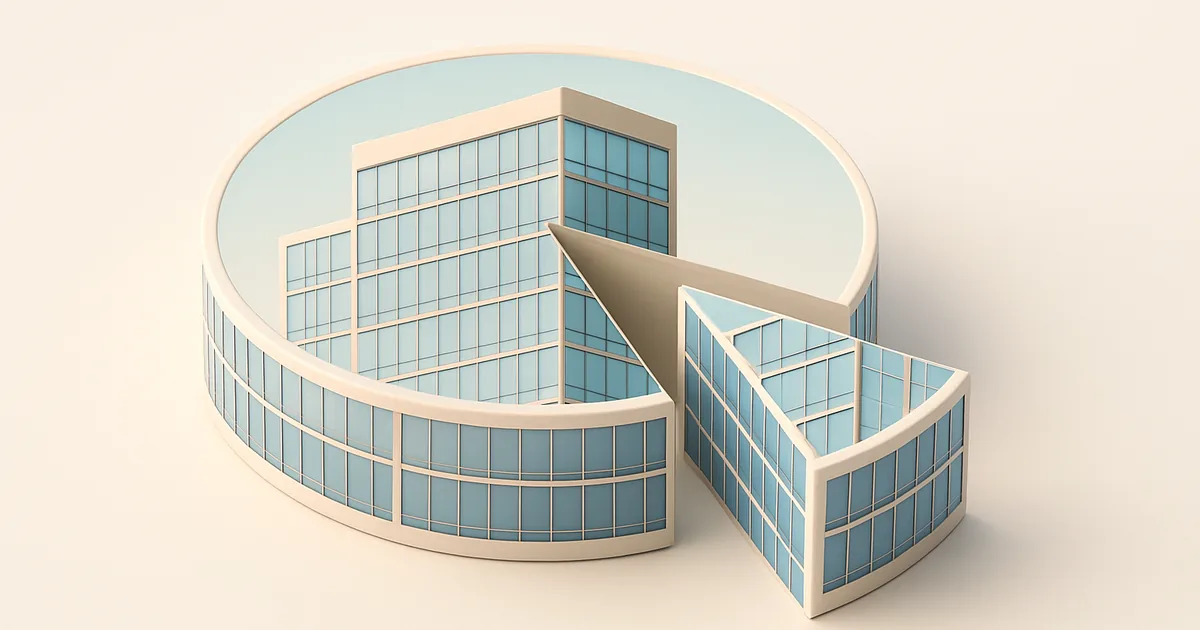
This is why the picture at the top of this page is a company cut like a pie. A share really is one wedge of the whole. Own more wedges and you own more of the business; own every wedge and you own the company outright, which is exactly what a takeover is.
What owning a slice actually gets you
Being a part-owner is not just a nice idea — it comes with real, if small, rights. Owning shares typically gives you three things:
- A claim on the profits. When the company makes money and decides to hand some back to its owners, you get a slice in proportion to how many shares you hold. That payment is a dividend.
- A vote. Shareholders get a say in big decisions — who runs the company, whether to approve certain deals — usually one vote per share. One small holder’s vote is a drop in the ocean, but the principle is real: owners get a voice.
- A stake in what the company is worth. If the business grows more valuable, your slice of it does too, and you can sell that slice to someone else for more than you paid.
That last point is where most beginners’ attention goes, and it is worth pulling apart properly.
Where shares come from in the first place
Shares do not appear from nowhere. A company creates them to raise money. Imagine a growing business that needs £50 million to build new factories. Rather than borrow it all from a bank, it can sell part of itself to the public: it divides ownership into shares and offers them for sale. This first big sale is called floating on the stock market, or an initial public offering — an IPO.
Here is the part that surprises people. After that first sale, the company is largely done. When you buy a share today, your money almost never goes to the company itself — it goes to whichever investor is selling the share to you. From then on, shares are simply passed from one owner to the next, at whatever price buyers and sellers agree. The place where all that swapping happens in an orderly way is the stock exchange, which we walk through in what a stock exchange actually does.
The two ways a share makes you money
This is the idea worth locking in, because it shapes how you judge whether owning a share paid off. A share can reward you through two completely separate channels:
- Capital growth — the share price rises, so the slice you own is worth more than you paid for it. You only actually collect this if you sell.
- Dividend income — cash the company pays you, a few times a year, simply for holding the share, whatever the price happens to be doing that week.
Add the two together and you get what professionals call your total return — the honest measure of how a holding treated you. It is a mistake to judge a share on its price alone. A steady, unexciting company whose price barely moved can still have been a fine holding if it paid a healthy dividend the whole time.
So why does the price keep moving?
If a share is a fixed slice of a company, why does its price jump around every single day? Because the price is not the fixed part — it is what buyers and sellers are willing to pay for that slice right now. And that depends on what people think the company is worth today, which shifts constantly with the news, the company’s results and the general mood of the market.
Good news — strong profits, a clever new product — makes people keener to own a slice, so they bid the price up. Bad news does the reverse. The slice itself has not changed; the crowd’s opinion of it has. That is the whole engine behind a share price, and it is worth reading how the news actually moves a share price to see it in action. It also explains why a falling price is not automatically a disaster — sometimes it is just the mood swinging, not the business breaking.
Shares versus stocks: is there a difference?
You will hear both words, often in the same breath, and it is easy to assume they mean different things. In everyday use they basically don’t. Stock is the general term for ownership in companies — “I own stock” — while a share is one specific unit of that ownership — “I own 50 shares.” Think of stock as the substance and a share as a countable piece of it, the way “water” is the substance and a “bottle” is a unit of it. For a beginner, treating them as the same thing will almost never lead you astray.
Yes, you can lose money — and that matters
Owning a slice of a business cuts both ways. If the company thrives, your slice becomes more valuable and may pay you along the way. If it struggles, the price of your slice can fall well below what you paid. And in the worst case — a company that fails completely — shares can end up worth nothing, because a slice of a business worth nothing is, itself, worth nothing.
This is not a reason to be scared of shares; it is the reason risk and reward are joined at the hip, a link we unpack in risk and reward, explained simply. It is also the single best argument for learning to invest with pretend money first. You get to make the beginner mistakes, watch how prices behave and feel the ups and downs — without a penny of your own on the line.
Seeing it for real in the Challenge
That is exactly what the Student Investor Challenge is built for. You get a virtual £100,000 to invest in real, listed companies, and you buy shares in them just as an adult investor would — only the money is imaginary and the mistakes are free. The moment you buy your first few shares, this whole article stops being theory. You are watching your slice of a real business rise and fall, seeing why the price moves, and starting to notice which companies feel solid and which feel like a gamble.
From there, everything builds. Once you hold a handful of shares in different companies you have quietly created a portfolio — and the whole game becomes learning to look after it wisely. But it all starts here, with the one idea underneath the entire market: a share is a slice of a real company, and when you own one, a small piece of that business is genuinely yours.
FAQ
What is a share in simple terms?
A share is one small unit of ownership in a company. If a business is divided into a million shares and you own one, you own a millionth of the whole company — along with a millionth of its future profits and a small say in how it is run.
What is the difference between a share and a stock?
In everyday use they mean almost the same thing. “Stock” is the general word for company ownership; a “share” is one specific unit of it. Saying you own stock in a company and saying you own shares in it amount to the same idea.
How do you make money from a share?
In two ways. The price can rise so your slice is worth more than you paid — capital growth — and the company can pay you part of its profit while you hold the share — a dividend. Added together they are your total return.
Can you lose money on shares?
Yes. Prices fall as well as rise, and if a company does badly its shares can be worth far less than you paid, or in a collapse nothing at all. That risk is exactly why a practice game with virtual money is a safer place to learn than real cash.
Learn it by playing it
Build a virtual £100,000 portfolio and buy shares in real companies — with none of the risk.
See how it works