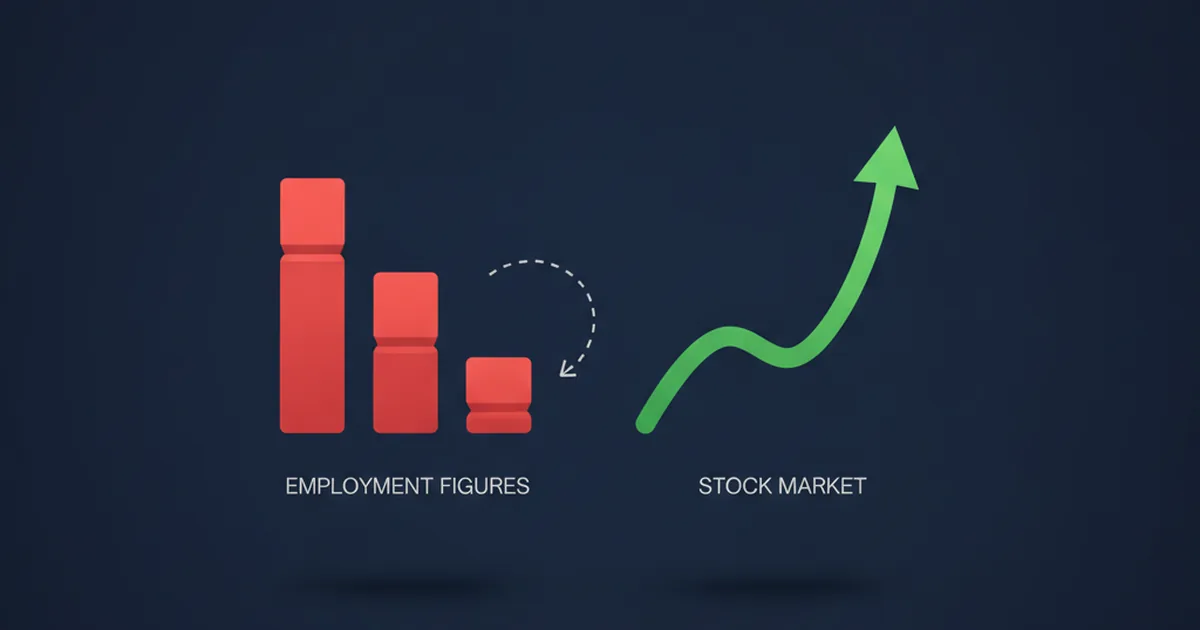
When good jobs news worries markets
On 5 September 2026, the United States reported that the economy added 162,000 jobs in August — more than three times what economists had predicted. Most people would call that brilliant news. Markets called it complicated. Here is the triangle that explains why.

A few weeks ago we looked at when bad jobs news is good for shares — a genuinely strange pattern where a weak report sends stock prices higher because traders expect the US Federal Reserve to hold interest rates steady. On 5 September 2026, we got the exact opposite: a spectacularly good jobs report that sent investors into a more complicated mood. Understanding why is the other half of the same lesson.
What the August 2026 report actually said
The non-farm payrolls report, published by the Bureau of Labor Statistics on the first Friday of each month, told markets three things about August 2026:
- Jobs added: 162,000. Economists had forecast a gain of just 53,000. The actual figure was more than three times larger — described by Babypips as the biggest monthly beat since March. The previous two months were also revised upward by a combined 55,000 roles, meaning the jobs market had been quietly stronger than anyone realised.
- Unemployment: 4.1%. The headline rate held exactly where analysts expected, unchanged from July. A stable unemployment rate on top of big job gains suggests the labour market is genuinely expanding, not just pulling people back from the sidelines.
- Wages: +0.3% in August, +3.1% over the year. Earnings are growing, but at a pace that, while solid, is not racing ahead of what the economy can sustain. That was one of the few details that gave markets a little comfort.
By any ordinary measure, this is a picture of a healthy economy churning out jobs at a robust clip. So why did it make investors nervous rather than euphoric?
The same triangle, running in reverse
To understand the market reaction, you need the same framework we used for the July report — but this time the arrows point in the opposite direction. Recall the three steps:
- Jobs → Fed rates. The Federal Reserve raises interest rates when the economy is running strongly and it worries that too much spending power will push prices higher (inflation). A weak jobs report usually means rates will stay on hold. A strong report, especially one that beats by this margin, raises the chance the Fed will raise rates to keep the economy from overheating.
- Fed rates → borrowing costs. Higher rates ripple through the financial system. Mortgages, business loans and credit cards all become more expensive. Companies that borrowed cheaply to fund growth suddenly face bigger interest bills.
- Borrowing costs → share prices. Pricier borrowing dents company profits. At the same time, higher rates make savings accounts and government bonds pay more interest, which draws money away from shares. The same investors who shifted into equities when rates were low now find bonds more attractive — so share prices can fall.
That chain of reasoning explains the headline reaction on 5 September 2026. As Bloomberg reported, market-implied odds of a Federal Reserve rate rise at its 16 September meeting jumped from about 52% before the report to 59% afterwards. In other words, investors went from “probably not” to “more likely than not” within minutes of the data landing.
What “market-implied odds” actually means
You will hear this phrase a lot when reading financial news. It refers to the probability of a central bank decision that traders are effectively betting on through financial contracts called interest rate futures. These contracts change hands constantly, and their prices shift every time new economic data arrives.
Think of it like a prediction market: before the August jobs report, 52 people in every 100 wagered the Fed would raise rates in September. After the report, that rose to 59 in every 100. That 7-percentage-point shift sounds small but represents hundreds of billions of dollars of repositioning across global markets. When rate expectations move, money moves — and share prices move with it.
This is the same logic explored in what interest rates do to shares: rates are the gravitational constant of financial markets. Everything from property values to company valuations orbits around them.
But wait — isn’t a strong economy good for shares?
Yes, and that is where it gets genuinely interesting. The August jobs figure was not bad news in an economic sense — 162,000 new workers earning wages means more spending power flowing through the economy, which is ultimately good for company revenues. The tension is between two forces pulling in different directions:
| Force | Direction | Effect on shares |
|---|---|---|
| Strong economy, higher profits | ↑ Up | Positive |
| Higher rate-hike expectations | ↑ Up (rates) | Negative |
Markets are constantly trying to weigh these two forces against each other. In August 2026, the rate-hike concern edged out the profit optimism in the very short term — but that balance can shift again at the next data release, the next Fed statement, or even a single speech from a central bank official.
Compare this with why the US inflation report moves markets: the same interest-rate logic applies there too. Strong jobs, high inflation, and a hawkish central bank all rhyme together in a way that keeps investors cautious even when the underlying economy is doing well.
The sector split
Not all parts of the market react to a strong jobs report in the same way. Here is a rough guide to who tends to benefit and who tends to suffer when rate-hike odds rise:
- Banks and financial firms: Often benefit from higher rates because they can charge more for loans. When rate expectations rise, bank shares frequently outperform. In the August 2026 report, food services and local government education added the most jobs, sectors less directly linked to market performance.
- Technology growth stocks: Often suffer. High-growth companies are valued partly on profits expected far into the future. Higher interest rates effectively shrink the “present value” of those distant profits — it is a mathematical squeeze. The August BLS report noted that information employment actually fell by 23,000, concentrated in computing infrastructure and web services, which added a second layer of concern for the tech sector.
- Utilities and property: Tend to perform poorly as rates rise because they carry a lot of debt and investors compare their steady dividends with bonds, which become more attractive when yields go up.
In the Student Investor Challenge, this kind of sector analysis is worth building into your thinking when you manage your virtual £100,000 portfolio. A strong US jobs report is not just a headline — it can shift the playing field between sectors in ways that last for weeks.
What the revision tells you
One detail buried in the August 2026 report deserves attention: June and July were both revised upward by a combined 55,000 jobs. July had initially been reported as a loss; it now shows as a gain of 21,000.
Monthly economic data is almost always revised at least once, sometimes several times. The first estimate is based on incomplete survey responses; later revisions incorporate more complete data. Savvy market-watchers always check the revision line because it changes the story of where the economy has actually been. In this case, the upward revision meant the economy had been stronger than anyone thought for two months running — which made the blowout August figure even harder for rate-cautious investors to dismiss.
Good news, complicated feelings
The overall picture from 5 September 2026 is a useful case study in how financial markets process information. The report was unambiguously positive for workers and for the general health of the economy. But markets do not simply celebrate good economic news — they ask what it means for the next thing: interest rates, company costs, and ultimately whether today’s strong growth will translate into tomorrow’s strong profits or tomorrow’s higher borrowing costs.
In the short term, rate-hike nerves dominated. Over a longer horizon, a labour market creating 162,000 jobs a month is a solid foundation for corporate earnings. The “good news is bad news” effect, like its inverse, is a short-term phenomenon driven by rate expectations — it does not mean a strong economy is bad for investors over time.
If you are tracking a portfolio in the Challenge, the main habit to develop here is this: when a major economic report lands, ask two questions in quick succession. First, what does it mean for interest rates? Second, what does it mean for corporate profits? The interaction between those two answers is where the market reaction lives.
The takeaway
On 5 September 2026, the United States reported adding 162,000 jobs in August — more than three times the forecast of 53,000. The unemployment rate held at 4.1%, wages grew 3.1% over the year, and prior months were revised higher. Rather than triggering a simple cheer from markets, the blowout figure sent rate-hike odds up from 52% to 59% for the Fed’s September meeting, putting investors in a cautious mood. The mechanism is the reverse of the familiar “bad news is good news” pattern: strong jobs suggest the central bank will tighten, higher rates squeeze company profits and make bonds more attractive, so equities can wobble even on excellent economic data. Understanding both sides of this triangle — the version where weakness helps shares and the version where strength complicates them — is one of the most practically useful frameworks you can carry into the Challenge and beyond.
This article is educational and is not financial advice. Jobs figures are from the official Bureau of Labor Statistics Employment Situation Summary, August 2026. Rate-hike odds and market reaction reported by Bloomberg and Babypips, 5 September 2026.
See it play out in real time
Track how jobs data, rate decisions and economic surprises move your virtual £100,000 portfolio in the Student Investor Challenge.
See how it works