US Consumer Confidence Falls to a Seven-Month Low — and What It Tells Investors
On 26 August 2026 The Conference Board reported that US consumer confidence slipped to 89.4 in August — its weakest reading since January and below economists’ forecast of 90.2. The headline number tells part of the story. The more interesting part is what lies underneath it.
What actually happened
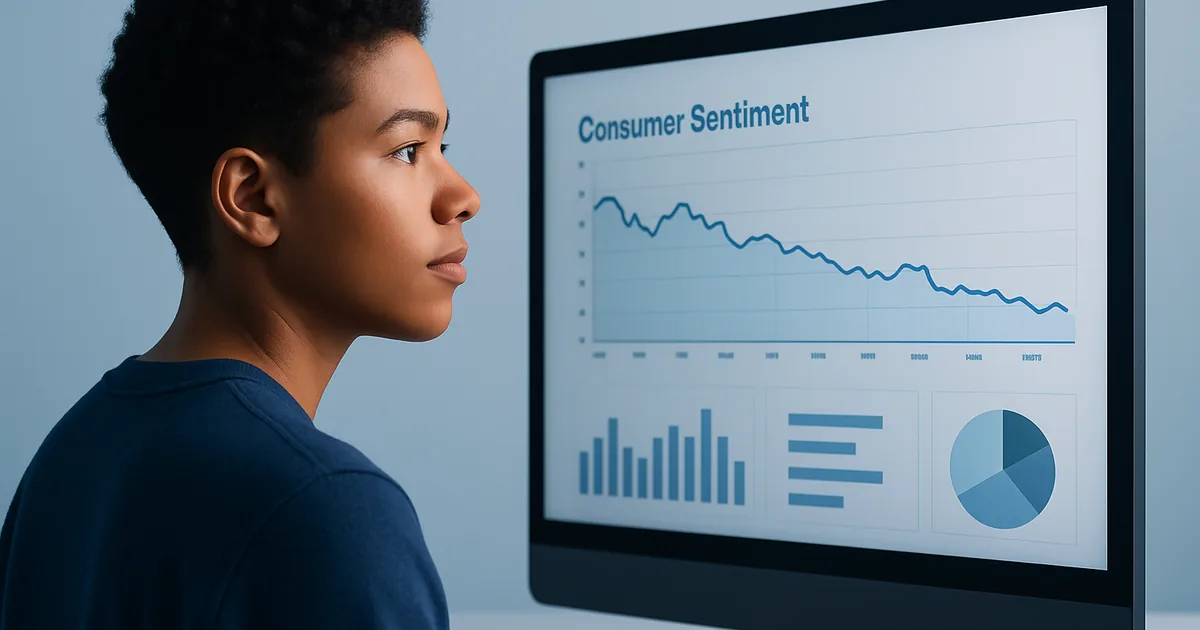
Every month, The Conference Board surveys around 3,000 US households and publishes its Consumer Confidence Index. In August 2026 the headline reading came in at 89.4, down 0.8 points from July’s 90.2. That put the index at its lowest point since January — a seven-month low, as Yahoo Finance and other outlets reported on the day.
The number was slightly below Wall Street estimates of 90.2, meaning the data arrived as a mild negative surprise. Markets had not fully priced in a reading this soft, which is why it drew attention across financial news channels.
What consumer confidence actually measures
It is worth being precise about what this index is and is not.
The Conference Board asks respondents to rate current business conditions (good, normal, or bad), current job availability (plenty, not so many, or hard to get), and then their expectations for business conditions, jobs, and income six months from now. Those answers are combined into a single number calibrated to a base year of 1985 = 100.
The index is a measure of sentiment — how people feel — not of what they are actually spending. That distinction matters. Sentiment can shift faster than behaviour. People might feel more anxious about the future but continue spending normally for several months. Equally, a recovery in confidence can run ahead of actual spending. This is why economists treat consumer confidence as a leading indicator: it tends to signal turning points before they fully appear in the spending data.
The split that tells the real story
The headline index is actually two very different readings rolled together, and August 2026 produced a striking split.
The Present Situation Index — how consumers feel about business conditions and jobs right now — rose by 6.8 points to 121.2. That is a meaningfully positive number. It suggests that many Americans feel relatively comfortable about their immediate situation: they see reasonable job availability and broadly acceptable conditions today.
The Expectations Index — the six-month forward view — fell by 5.8 points to 68.2. This is where the concern lies. The Expectations sub-index is the part that gets economists’ attention, because it is a better predictor of future behaviour. When people expect conditions to worsen, they often start preparing for it: spending less, saving more, delaying big purchases.
| Component | August 2026 | July 2026 | Change |
|---|---|---|---|
| Headline Index | 89.4 | 90.2 | –0.8 |
| Present Situation Index | 121.2 | 114.4 | +6.8 |
| Expectations Index | 68.2 | 74.0 | –5.8 |
That combination — present strong, future weak — tells a specific story. It means people feel OK today but are increasingly uncertain about what is coming. Higher inflation expectations (5.8% over the next twelve months, up from 5.6% in July) suggest many households are bracing for the cost of living to stay elevated. That kind of anxiety, if it persists, can eventually feed into lower spending even when current conditions remain reasonable.
Why the 80 level on Expectations matters
The Conference Board itself has noted that an Expectations Index reading below 80 has historically often been associated with a recession within the following twelve months. August’s reading of 68.2 is clearly below that threshold, which is why several economists flagged it as a warning sign — even while emphasising that one month’s data is never conclusive.
It is important to understand what that threshold actually means. It is not a guarantee. It is a pattern observed over decades of data: when the forward-looking part of consumer confidence falls this sharply, consumers often do eventually cut spending, which weighs on business revenues, which can drag on the broader economy. But the relationship takes time to play out, and plenty of conditions can interrupt it — a fall in energy prices, a stronger jobs market, or a policy change that reassures households.
For a Student Investor perspective: this is a useful moment to learn about what a recession actually is and how investors try to anticipate one from leading indicators like this.
Why markets care about consumer confidence
Consumer spending accounts for roughly 70% of US GDP. That single fact explains why confidence data gets so much attention. If households pull back on spending, the revenues of businesses that sell to them — retailers, restaurants, car manufacturers, airlines, tech platforms — fall. That reduction in revenue hits earnings, and lower earnings expectations push share prices down.
The transmission is not instant. Markets react to confidence data because they are trying to get ahead of a chain of events that may not be fully visible for several months. Experienced investors ask: if people are this anxious about the next six months, will they cut discretionary spending? Which companies in my portfolio rely most on that discretionary spending? Am I overexposed to consumer-facing sectors at a moment when the forward data is weakening?
That kind of forward-thinking analysis is exactly what the Student Investor Challenge practises. Understanding how inflation expectations shape spending decisions is part of building that picture.
Which shares tend to react most
Not all companies are equally exposed when consumer confidence falls. A few general patterns are worth knowing:
- Discretionary retailers (clothing, electronics, luxury goods) — high sensitivity. These are the companies people stop buying from first when they feel uncertain about the future.
- Travel, airlines, leisure — also high. Holidays and eating out are among the first things households defer when they are worried.
- Consumer staples (food, household products, basic pharmaceuticals) — lower sensitivity. People keep buying washing-up liquid and bread regardless of how anxious they feel.
- Banks — moderate sensitivity. Weaker consumer confidence can reduce loan applications and raise worries about credit quality.
- Utilities and healthcare — lowest sensitivity. These are often called “defensive” sectors precisely because demand for them barely changes with the economic cycle.
This is one reason why investors talk about rotating a portfolio between cyclical and defensive shares depending on where they think the economy is heading. When confidence data starts to soften and inflation expectations rise, some professional investors shift weight towards staples and utilities and reduce exposure to discretionary retailers.
The US data and global markets
It is worth noting that the US consumer confidence reading affects not just American shares but global markets too — including the London Stock Exchange, where Student Investor participants choose their shares.
Many FTSE 100 companies generate a significant portion of their revenues in the United States. A weakening US consumer is therefore a headwind for UK multinationals in areas like luxury goods, consumer brands, and technology. When this data landed on 26 August, European markets took note alongside US ones.
Understanding how economic data from one country ripples into another is an important layer of analysis. You can see a related example in how the US inflation report moves markets globally — the same logic applies here.
What to watch next
A single month of softening confidence is not a verdict. Investors and economists will be watching several things in the weeks ahead:
- September’s Conference Board reading — does the Expectations Index stay below 80, or does it recover? A stabilisation would ease some concerns; a further drop would deepen them.
- US retail sales and jobs reports — these show whether the sentiment shift is translating into actual behaviour changes, or whether consumers are worried but still spending.
- Inflation data — the same day as the confidence reading, the core PCE price index (the US Federal Reserve’s preferred inflation measure) came in at 3.3% year-on-year for July, in line with forecasts. If inflation begins to ease, confidence could recover quickly as households feel less pressured on the cost-of-living front.
For participants in the Student Investor Challenge, this is a good moment to review how much of your virtual portfolio is exposed to consumer-facing sectors and to ask whether that exposure makes sense given the current forward indicators. Managing that kind of risk — reacting to real data rather than guessing — is one of the core skills the challenge is designed to build. You can learn more about how the virtual portfolio works on our how it works page.
FAQ
What is the Conference Board Consumer Confidence Index?
It is a monthly survey of around 3,000 US households published by The Conference Board, a non-profit research organisation. Respondents are asked how they feel about current business conditions and jobs, and how they expect conditions to change over the next six months. The answers are combined into a single index number, with higher meaning more confident. A reading above 100 has historically been associated with solid consumer spending; a sustained fall below 80 on the Expectations sub-index has often preceded a recession.
Why did consumer confidence fall in August 2026?
The Conference Board said the drop was driven by the Expectations Index — the forward-looking part of the survey — which fell to 68.2 in August from 74.0 in July. Consumers grew more worried about the six-month outlook for jobs, income, and business conditions. They also raised their one-year inflation expectation to 5.8%, suggesting many households expect the cost of living to keep rising. The Present Situation Index, which covers current conditions, actually rose — so people feel all right today but are less sure about tomorrow.
Does a fall in consumer confidence mean a recession is coming?
Not automatically. Consumer confidence is a leading indicator, meaning it can signal trouble before it actually arrives — but it can also recover quickly if conditions improve. The Conference Board notes that an Expectations Index reading below 80 has historically been associated with a recession within the next twelve months, which is why August 2026’s reading of 68.2 drew attention. However, one month of data is never conclusive. Investors watch for whether confidence keeps falling or stabilises, and combine it with other readings — jobs data, retail sales, inflation — before drawing firm conclusions.
Practise reading economic signals with a virtual portfolio
Track real market-moving data like consumer confidence with a virtual £100,000 portfolio — no real money, real lessons.
See how it works